AI Operations Manager in Slack: What to Hand Off Before You Hire
When every recurring operating task still routes through the founder, the business slows down whenever the founder is busy. Nobody knows who owns the delayed client project, the Monday numbers go out late, and the process for onboarding a customer lives in one person's head and three old Slack threads. The usual answer is to hire an operations manager. A newer answer is to buy an "AI operations manager".
This guide is for founders, owners, and ops generalists at Slack-first firms of roughly 5 to 100 people who are about to make that choice. It shows how to split an operations job into the part an agent in Slack can run today, the part that needs a written process first, and the part that still needs a manager, so the hire you eventually make is the right one.
Tasks or decisions: the question to answer first
An operations manager is a broad role. The O*NET profile for general and operations managers describes people who "plan, direct, or coordinate the operations" of an organization, and it lists Operations Manager among its sample job titles. That covers planning and deciding as well as coordinating.
Two hiring guides that rank for this decision draw the same line. Pro Sulum's guide on when to hire an operations manager, from a firm that sells a "Virtual Systems Architect" service, asks whether you have "a leadership gap or an execution gap" and warns that hiring a senior manager to run "undocumented chaos usually just moves the chaos around". Founder's Best Friend's guide to a first operations hire separates an operations coordinator, who "owns execution of existing processes", from an operations manager, who "owns execution plus improvement".
So before you post a job or start a trial, take the job description you would post and mark each line as a task or a decision. A task has a known trigger and a known output: post the weekly status, chase the overdue invoice, log the call in the CRM. A decision needs judgment about people, money, or priorities: reassign the project, push back on a client, change the process. Sort the operations job description into tasks and decisions before you hire or buy anything, because a list that is mostly tasks calls for a coordinator or an agent, and a manager hired into it spends the first months copying status. You would also be paying manager rates for that copying. This is our recommendation, built on the coordinator and manager split in those guides.
What vendors mean by an AI operations manager
The pages that rank for "ai operations manager" are mostly vendor pages, and they promise the whole role. CellCog's AI Operations Manager page says "an operations manager costs about $138,000 a year once salary and benefits are counted" and offers an AI employee for "a fraction of that". Spinnable's AI Operations Manager page says its worker updates task boards and chases blockers "with polite follow-ups, without you prompting". Both are vendor claims.
Slack frames the same job more modestly. Its post on AI for small business says AI in operations "focuses on reducing the coordination work that builds as business grows", and lists summarizing meetings, managing task lists, routing requests, and handling repeatable internal processes. That is coordinator work. None of these pages helps you work out which of your own job description's lines an agent can actually run, or what has to be true about your tools and processes first.
Sort the job description into three columns
Put the draft job description on one page and sort every line into one of three columns.
| Column | What belongs here | Who runs it |
|---|---|---|
| Recurring and rule-based | Weekly status brief, overdue list by owner, CRM notes from a thread, invoice and payment checks | An agent on a schedule or trigger, with your approval on writes |
| Needs a written process first | Client onboarding steps, month-end handoffs, vendor reorder rules | You or the agent drafts the SOP, you approve it, then it runs |
| Judgment and relationships | Reassigning work, hard conversations, vendor negotiation, phone calls, changing priorities | A person |
In Kipwise's 27 September 2026 review of public Upwork job posts, 15 team-chat posts had both "operations" and "manager" in the title. The estimated share of listed tasks that an agent in Slack could do ranged from 5% to 40%, with a median of 25%. That figure is a Kipwise estimate from post text and does not measure any team. Even at the top of that range, most of each job stays with a person.
The pain lines in those posts are about coordination rather than strategy: "too much of it still routes through the owner", "leadership does not have to chase routine execution", and "nothing falls through the cracks". Those are the lines to move first.
Write the SOP before anything runs it
An agent, like a new hire, can only follow a process that has been written down. The Founder's Best Friend guide says you are ready for an operations hire when you have "at least three documented processes (even rough ones)", and that otherwise the new person spends their first 90 days asking how each task is done. The same holds for an agent, except that an agent will not keep asking. Give it an unwritten process and it will either refuse or produce something plausible that is not how your team works.
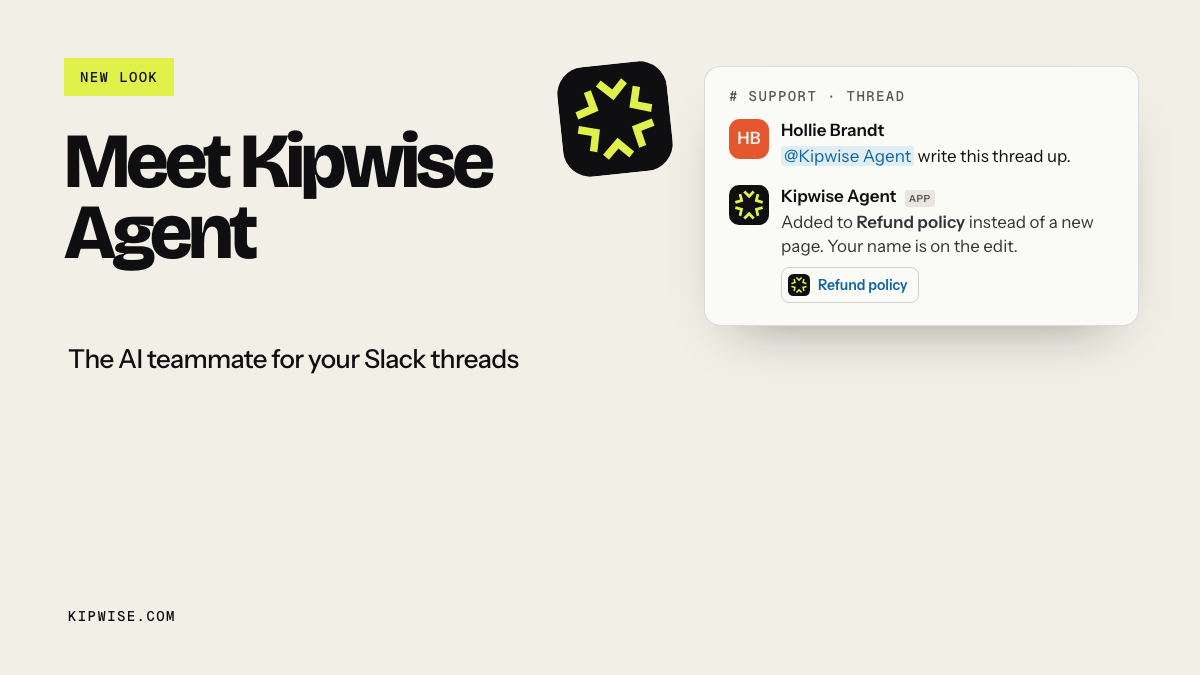
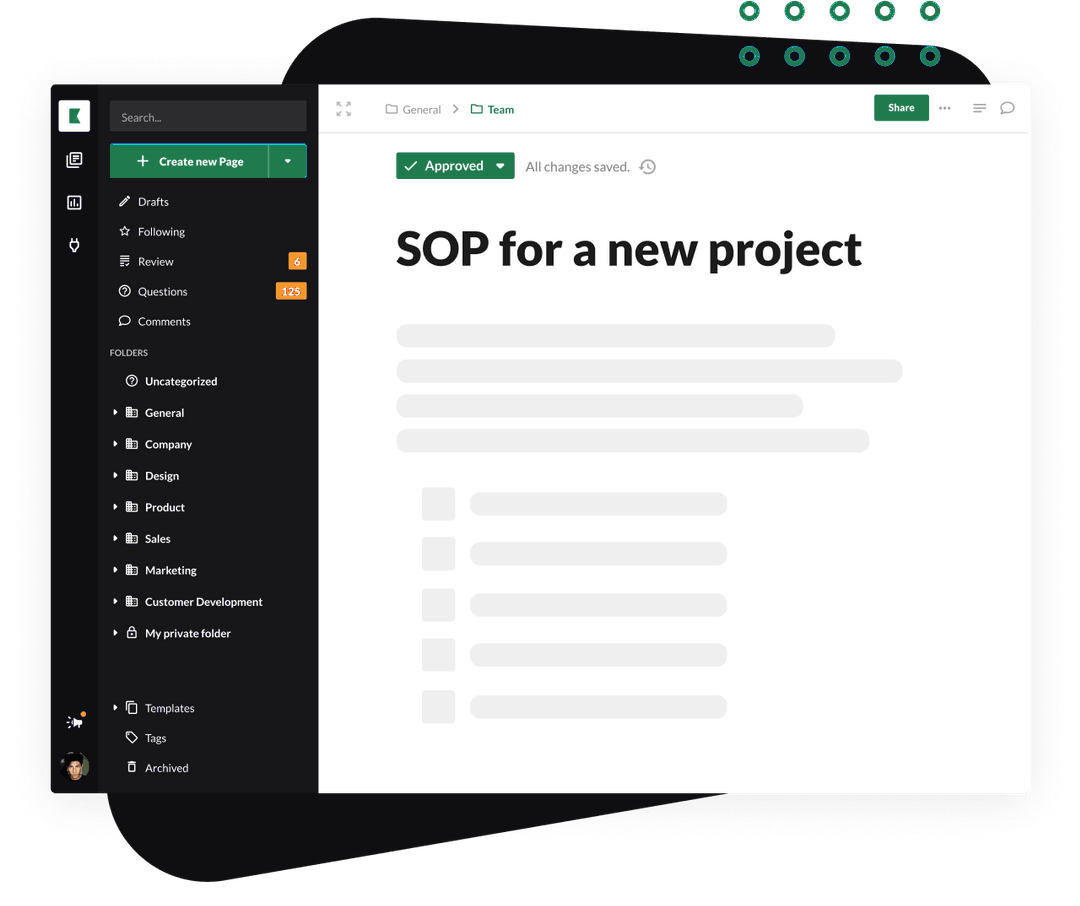
Most small teams have already settled their processes in Slack threads, even if nobody wrote them up. With Kipwise, you can ask the agent in the thread where a process was agreed to write it up. It drafts a Kipwise page from what was said, files it in the folder you name, and posts the link, and the page shows you as the author because it wrote it as you. Have the agent draft each SOP from the Slack threads where the process was settled and approve it yourself before any schedule runs it, because an agent or a new hire can only follow a process that is written down. Read the draft, fix what is wrong, and only then schedule anything that depends on it.
This order matters more for an agent than for a person. A person who finds a gap in the SOP flags it. A scheduled job runs the same flawed step every week until someone notices, so approve the SOP before the schedule, not after the first bad run.
Check the agent against your task tool
The most common gap in those 15 operations-manager posts was access to the project board. Check an AI operations manager against the task tool your team actually uses, because in Kipwise's review of 15 operations-manager job posts, 9 named ClickUp, Asana, Monday, or Trello as work an agent could not do, and an agent that cannot write to your board can only report on it. Two posts also listed holding people accountable with judgment.
Before you compare features, check three things against the stack you actually run:
- Can it read and update the system where work is assigned (your issue tracker or project board)?
- Can it read the system where money and customers live (CRM, invoicing, payments)?
- Can it write the process down somewhere your team already looks?
Kipwise Agent connects to Linear and Jira for issues, HubSpot and Pipedrive for deals, Stripe, Xero, and QuickBooks for billing, and Kipwise pages for the written process, each through your own account. ClickUp, Asana, and Monday are not among its named connections. If your operations run in one of those, the agent can still compile status from Slack and your other tools, but updating the board stays with a person. Know that before you buy.
Keep nudges and writes behind your approval
The coordinator work that matters most, chasing people, is also the riskiest to hand over, because every nudge carries the sender's authority. Slack's agent design guidance for developers says that when an agent acts using someone's identity, that "should always be visible and reviewable", and that an agent "shouldn't be able to read, access, or use information that the invoking user wouldn't be able to access on their own".
Kipwise Agent follows that pattern. Before a live request changes something in a connected tool or posts a message, it shows an Approve or Deny card that only the person who asked can use, and the card expires after 30 minutes. A scheduled task is approved once when you create it, and its later runs do not ask again, so the approval you give at setup is the one that counts. It also reads with your own connections, so a page or deal you cannot open is not read to you.
In practice, start with nudges drafted in the ops thread for you to approve or send. Move a nudge to a schedule only after a few weeks of sending it unchanged.
What still needs a person
Some lines in an operations job description will stay human for now, and an honest evaluation names them:
- Phone calls and live conversations with clients, vendors, and staff.
- Negotiation and judgment with outsiders, such as pushing back on scope or chasing a supplier who has gone quiet.
- Holding people accountable when the reminder has already gone out twice.
- Changing the process itself, which is the "improvement" half of the manager role in the Founder's Best Friend definition.
- Work that lives only inside a tool the agent cannot reach.
That list is why we suggest putting the repetitive part in Slack before you hire and keeping a person for the rest.
Compare the cost honestly
The figures in this category vary widely, so label each one. The Founder's Best Friend guide puts an operations coordinator at $45K to $65K, an operations manager at $65K to $95K, and fractional operations help at $2K to $4K a month for 10 to 20 hours a week. CellCog's $138,000 for a fully loaded operations manager is a vendor figure. In Kipwise's review, the 12 operations-manager posts with an hourly range had a median midpoint of $13.25 an hour, which reflects offshore marketplace rates rather than a US salary.
Kipwise Agent costs $10 per user per month with a minimum of 3 users. That price only matters if it removes enough recurring work to change the hire. Compare it with the coordinator hours it saves, not with a manager's salary, because it does not do the manager's job.
There is also a cost to hiring too early. A commenter in a Hacker News thread on lessons from scaling from 10 to 20 people put it this way: "Every employee you bring on adds not only burn rate, but also communication overhead." That is one practitioner's view, but it matches the hiring guides above.
What native Slack covers
Before buying anything, check what Slack already does. Slack's guide to Workflow Builder explains that workflows can start on a schedule or from Slack actions such as an emoji reaction or someone joining a channel. For a fixed weekly reminder or a form that routes requests, that may be enough.
Workflow Builder runs the steps you define. It does not read your issue tracker and CRM, decide which items are overdue, and write a brief that links each source. An agent is worth adding for that multi-tool step and for drafting the SOP from a thread.
An illustrative example
The following example is made up to show the flow. A 14-person web agency runs on Slack, Linear, HubSpot, and QuickBooks. The founder drafts an operations manager job post with 18 lines, then sorts them. Nine are recurring tasks: the Monday status brief, overdue Linear issues by owner, HubSpot deals with no next step, unpaid invoices over 30 days, and similar checks. Four need written processes first, including client onboarding and the month-end handoff to the bookkeeper. Five are decisions or relationships.
The founder asks the agent, in the threads where onboarding and the month-end handoff were agreed, to write each one up, edits the two pages, and approves them. Then she schedules the Monday brief and a Thursday overdue check, both approved once at setup. Nudges are drafted in the ops thread for her to send. After four weeks, the job post shrinks to the five judgment lines plus process improvement, and she hires a part-time operations manager to own those instead of a full-time coordinator to copy status.
Failure modes to plan for
- Scheduling an unwritten process. The agent runs a guess every week. Write and approve the SOP first.
- Buying for a board the agent cannot reach. Check tool coverage against your stack before the trial.
- Letting nudges go out unreviewed. People learn to ignore an agent that chases badly, and the founder's authority suffers with it.
- Treating the brief as the decision. A list of overdue items is input for a manager, not a replacement for one.
- Hiring a manager into a task list. If the sorted job description is mostly tasks, the hire is a coordinator.
Pilot it for four weeks
Run a short pilot before you post the job:
- Week one: sort the job description into the three columns and count the lines in each.
- Week two: have the agent draft SOPs for the processes in the middle column and approve them.
- Week three: schedule the recurring brief and one overdue check, with nudges drafted for approval.
- Week four: measure what moved. Count recurring tasks that no longer touch the founder, overdue items per owner week over week, SOP pages written, and the lines left for a person.
At the end, rewrite the job post using only the lines that are left. If they are mostly decisions, hire a manager to own them. If a few tasks remain that need a phone or a tool the agent cannot reach, a part-time coordinator may be enough. For the status part of the job, our guide to team status updates in Slack without an ops coordinator covers the implementation, and if the role you are really weighing is a right hand for the founder, read our guide to an AI chief of staff in Slack.
Start today by pasting your draft operations job description into a Kipwise page and marking each line as a task or a decision.
References
- O*NET OnLine: General and Operations Managers (11-1021.00): official occupational definition and sample job titles.
- Pro Sulum: When to hire an operations manager: leadership gap versus execution gap, and the risk of hiring into undocumented processes.
- Founder's Best Friend: How to hire your first operations person: readiness tests, coordinator versus manager scope, and pay ranges.
- CellCog: AI Operations Manager: vendor replacement claim and cost figure.
- Spinnable: AI Operations Manager: vendor claim of autonomous chasing and task-board updates.
- Slack: AI for small business: Slack's framing of operations AI as reducing coordination work.
- Slack Developer Docs: Agent design: visible, reviewable actions on a user's behalf and the invoking user's data boundaries.
- Slack Help: Guide to Workflow Builder: scheduled and event-started workflows in native Slack.
- Hacker News: Lessons scaling from 10 to 20 people: a practitioner comment on the overhead each hire adds.
- Kipwise Agent: product page with pricing.
- Kipwise: Team status updates in Slack without an ops coordinator: implementation guide for the status part of the role.
- Kipwise: AI chief of staff in Slack: the related guide for a founder's right-hand role.