Agentic Workflows for a Small Slack Team: What to Run First and What to Keep Human
Most guides to agentic workflows are written for enterprise IT or for developers. If you run a 5 to 100 person company on Slack, you have a narrower question: which recurring job should an agent take first, where does a person still approve, and is it enough to stop you hiring a coordinator or VA for the repetitive part? A wrong pick is easy to miss. You end up with a clever setup for a task that happens twice a month while the follow-up chasing that eats your week stays manual, or an agent that sends a customer the wrong number. This guide gives you a four-question filter for the first job, five agentic workflows a small team can run in a Slack thread, and the approval rules that keep the risky parts with a person.
The short answer
- Pick one job that repeats every week, has bounded inputs, and already has a manual version someone runs.
- Run it in a Slack thread first, read-only, and look at what it produces for two weeks.
- Let it write to internal tools behind an approval card. Keep anything a customer reads as a draft a person sends.
- Put it on a schedule only after the output is right without edits most weeks.
- Hire a person for what is left: judgment, relationships and the exceptions.
What "agentic workflows" means in plain words
Anthropic's engineering post Building effective agents draws the line most other guides blur. Workflows are "systems where LLMs and tools are orchestrated through predefined code paths". Agents are systems where "LLMs dynamically direct their own processes and tool usage". Both sit under the umbrella of agentic systems. The same post recommends "finding the simplest solution possible, and only increasing complexity when needed", and notes that agents trade latency and cost for flexibility.
For a small team the distinction decides how you set up the job. A weekly status roll-up has the same steps every time: read these channels, group by owner, flag what is late. That is a workflow, and you want it predictable. Working out why a client's onboarding stalled, across email, the CRM and three threads, has no fixed path. That is closer to an agent. Most good first jobs are the first kind with a little of the second: fixed steps, with a model doing the reading and summarising inside each step.
The enterprise guides add useful guardrails but assume an IT team. Dataiku's agentic workflows guide (March 2026) gives a 7-step rollout starting with a readiness audit and a pilot scoped to "one workflow, one team, one measurable KPI", and advises human approval "when decisions affect customers, money, or compliance". Box's agentic workflows guide describes workflows that pause for human approval on sensitive steps and log every action. Both are written for organisations with a platform team. Neither says which job a founder with a Slack workspace and a HubSpot account should hand over on Monday, or how the work shows up in the threads the team already uses.
Why small teams pick the wrong first job
The failure is rarely the model. A practitioner who builds inbox and lead automations for small businesses put it directly in a 25 July 2026 r/AI_Agents thread: an impressive agent built for a task that happens twice a month "demos beautifully and changes nothing", while the job eating six hours a week never gets touched. That is one author's report, and the author promotes a related kit in the comments, but it matches what the enterprise guides say in more formal language.
Three things push teams toward the wrong job:
- Irritation beats arithmetic. The task that annoys the founder most gets picked, not the one that costs the most hours.
- Ambition beats boundaries. "Handle my Slack" sounds like the biggest win, but its inputs are unbounded, so the agent invents categories as it goes.
- Capability beats consequences. Teams ask whether the model can write the client email, not what one wrong client email costs.
A four-question filter for the first job
Write down every repetitive coordination job your team or your would-be hire does in a week. Then run each through four questions. The first three follow the practitioner thread above; the fourth is our recommendation.
1. How many hours does it really take? Rank candidate jobs by times per week multiplied by minutes each, not by how annoying they feel, because the job that irritates the founder most is often not the one eating the most hours. A daily ten-minute chase is 50 minutes a week. A monthly report that takes two hours is about 30. The chase wins, even though the report feels heavier. Do the multiplication on paper before you decide.
2. Are the inputs bounded? The thread's example is inbound email, where intent falls into a handful of buckets (pricing, booking, complaint, spam). If you cannot write the categories down, the job is not ready. A related rule from a commenter in the same thread is worth adopting as a gut check. Choose a first job you can describe in one sentence without an except-when clause, because a frequent task with a dozen hidden exceptions costs more supervision than a boring, uniform weekly one. That commenter describes picking an invoice-matching job that looked simple, finding eleven vendor formats behind it, and taking three weeks longer than the lead-routing job they almost chose instead. "Every Monday, list open deals with no next step, by owner" passes. "Reconcile invoices, except when the vendor uses the old template, except when..." does not, yet.
3. What does one wrong output cost? Set the approval point by what one wrong output costs, not by how capable the model looks, so anything a customer reads starts as a draft a person approves while internal summaries can run on their own. The thread's author goes further for customer-facing work: draft-only, with the workflow never calling the send step at all. Remova Tech's 15 business examples reaches the same place from the vendor side: avoid sensitive final decisions at first, and keep payment approval, hiring, legal approval and customer commitments with an accountable person. A wrong internal status line costs a reply in the thread. A wrong price in writing to a client costs a relationship.
4. Is there a manual version someone already runs? This one is our recommendation. If nobody does the job by hand today, you have no baseline to compare against and no one who knows what good output looks like. Remova makes a related point: if a report is no longer read, stop making it rather than automating it. Start with a job that has an owner, a current format and a person who will notice when it is wrong.
A job that scores well on all four is your first agentic workflow. A job that fails question 2 or 3 stays with a person for now, or waits until you can write its rules down.
Five agentic workflows a small team can run in Slack
These five pass the filter for most Slack-first teams of 5 to 100 people. Each shows who asks, what the agent does and where a person approves. Kipwise has single-topic guides for several of them, linked below.
| Job | Typical weekly cost by hand | Inputs | Agent does | Person approves |
|---|---|---|---|---|
| Weekly status roll-up | 1 to 3 hours of asking and collating | Project channels, Linear or Jira | Reads updates, groups by owner, flags silence | Posting to the wider channel |
| Follow-up chase | Daily, 10 to 30 minutes | Starred threads, CRM deals with no next step | Lists open loops by owner, drafts nudges | Each CRM write and each nudge |
| Monday operating brief | 1 to 2 hours | CRM, issue tracker, payments | Pulls numbers, compares to last week, notes gaps | Nothing, if it is read-only in a thread |
| New deal or payment handoff | Per event, 10 to 20 minutes | HubSpot deal created, Stripe payment received | Reads the record back, posts a checklist in the channel | Any change to the record |
| Client update draft | 30 to 60 minutes per client | Project threads, tracker, last update | Drafts the update from the week's work | The person sends it, every time |
The hours column is an illustrative range for a small team, not a measurement. Replace it with your own times-per-week multiplication.
Status roll-up. Someone mentions the agent in a project channel thread and asks for every update from the last week, grouped by owner, with anything silent for seven days flagged. Getting team status updates in Slack without an ops coordinator covers this job end to end.
Follow-up chase. The agent lists open loops and drafts the nudge. A person approves each write. See keeping follow-ups from falling through the cracks in Slack.
Monday brief. A read-only job in one thread, then a schedule. Scheduling recurring AI agent jobs in Slack without silent failures covers what to check when a scheduled run fails.
Event handoff. Instead of a time, the trigger is an event in a connected tool. The agent should read the record back before acting, not trust the notification alone.
Client update draft. It is tempting to automate this one first. Keep it draft-only longest, because a customer reads it.
How it runs in a Slack thread
Here is a made-up example, not a customer story. Priya is the ops generalist at an 18-person design studio that uses Slack, HubSpot and Linear. She was about to post a part-time coordinator role. Instead she opens a thread in #ops and mentions the agent once: "Every Monday at 9, list HubSpot deals with no next step and Linear issues with no update in seven days, grouped by owner." She replies in the same thread to drop one pipeline she does not care about. The first run comes back read-only in the thread. When she asks it to put the list on a schedule, she approves that once. Two weeks later she lets it draft nudges and CRM notes, and each one waits on an Approve or Deny card that only she can use.
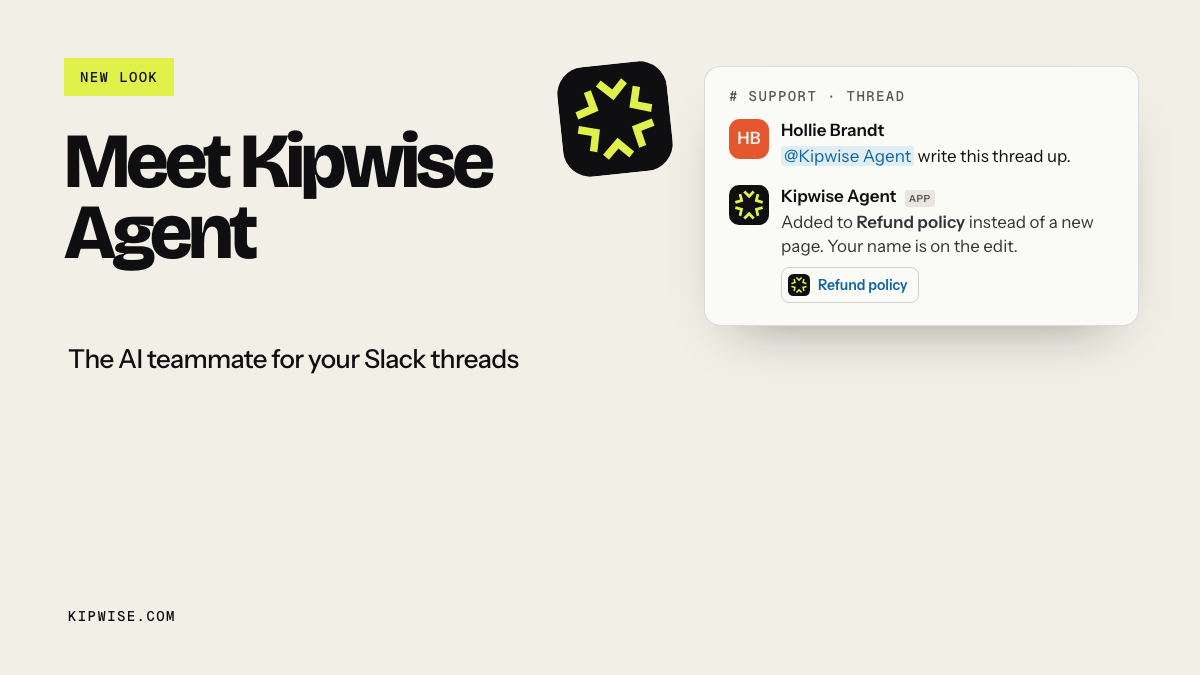
That is how the Kipwise Agent works. You mention it once in a channel thread and plain replies continue the conversation. It acts with the asking person's own access in each connected tool, so it cannot read a deal or page you cannot open. Before a live request changes something in a connected service or posts a message, it shows an Approve or Deny card that only the asker can use, and the card expires after 30 minutes. A scheduled task needs approval once, and its later runs post to the channel without asking again. It can also act when something happens in a connected tool, such as a deal being created in HubSpot or a payment arriving in Stripe, and it reads the record back with your tools first. The architecture behind this is in how to build a thread-native AI agent for Slack, and the approval cards are covered in adding human approval to AI agent workflows in Slack.
What to keep with a person
Agentic workflows move the repetitive part, and someone still answers for the result. Keep these with a person, whatever the tool:
- Choosing which job to automate. The filter above is a judgment call about your business.
- Anything a customer reads before it is sent. Draft-only until you have weeks of evidence for one narrow message type.
- Money, hiring, legal and pricing exceptions. Both Dataiku and Remova put these behind human approval, and a small team has less room to absorb a mistake than an enterprise.
- Complaints and relationship calls. The commenter's rule from the thread applies: complaints, pricing exceptions and ambiguous account details stay draft-only.
- Fixing the process itself. If three people disagree on how a job should run, an agent will not settle it.
Decide autonomy one job at a time. A commenter in the practitioner thread suggests running each message type in draft mode first, recording how often a person edits it, and graduating only a narrow slice, such as appointment confirmations, to sending on its own. Base each promotion on the edits you recorded for that message type.
When it fails, and what to do
- Stale source data. The brief lists a deal that closed last week. Fix the data hygiene in the CRM first; do not add outreach on top of a bad list.
- The job had hidden exceptions. Edits climb instead of falling. Narrow the scope until it passes the one-sentence test again.
- A scheduled run fails quietly. Ask the agent what happened on previous runs. With Kipwise you can list your jobs and ask about past runs, including failures, so check that history weekly during the pilot.
- Permissions surprise someone. The agent uses the asker's access, so a teammate who cannot see a deal will not get it in their brief. Decide whose job it is and have that person set it up.
- An approval card expires. Nothing runs. That is the safe default; ask again when you are back.
How to tell it worked
Run a four-week pilot on the one job that passed the filter.
- Week 1: read-only in a thread. Write down the minutes the job took by hand that week.
- Week 2: still read-only. Count corrections you would have made before sharing the output.
- Week 3: allow approved internal writes. Count cards approved unchanged versus edited or denied.
- Week 4: put it on a schedule if most cards went through unchanged.
At the end, compare three numbers: minutes per week before and after, the share of outputs approved without edits, and the open loops that closed without you chasing them. If the minutes fell and the edits are rare, take the next job off your list. If the edits stayed high, the job failed question 2, and no prompt change will fix that. If the work left over is mostly judgment and relationships, that is when a hire makes sense, for those parts, not for status chasing.
What to do next
Today, list the repetitive coordination jobs your team does each week and write times per week times minutes next to each. Circle the top one that passes the one-sentence test and has a low cost of being wrong. If your team works in Slack, open a thread, ask an agent to do that one job read-only, and compare its output with what you would have written. Kipwise Agent costs $10 per user per month with a 3-user minimum and has a free trial, so you can run the first two weeks of the pilot before you decide whether to hire. The Kipwise Agent introduction shows what it looks like in a thread.
References
- Building effective agents: Anthropic, Dec 19, 2024. Workflow and agent definitions and the advice to choose the simplest solution.
- Agentic workflows guide: definition, patterns, and use cases: Dataiku, March 22, 2026. Enterprise 7-step rollout and human approval for decisions affecting customers, money or compliance.
- Agentic workflows: The ultimate guide: Box Blog. Human approval on sensitive steps and action logging, written for larger organisations.
- Agentic Workflows: 15 Business Examples: Remova Tech, updated March 17, 2026. First-pilot criteria and the decisions to keep with a person.
- The hardest part of shipping agents for small businesses isn't the agent, it's picking the task: Reddit r/AI_Agents, July 2026. Author report on task selection, draft-only customer output and per-intent graduation, plus commenter reports.
- Kipwise Agent: Product page for threads, approvals, schedules and price.
- How to Get Team Status Updates in Slack Without Hiring an Ops Coordinator: The status roll-up job.
- How to Keep Follow-Ups from Falling Through the Cracks in Slack: The follow-up job.
- How to Schedule Recurring AI Agent Jobs in Slack Without Silent Failures: Scheduled jobs and failure checks.
- How to Build a Thread-Native AI Agent for Slack: Thread continuity and architecture.
- How to Add Human Approval to AI Agent Workflows in Slack: Approval cards.
- Meet Kipwise Agent, the AI teammate for your Slack threads: Product introduction.