How to Set Up Expense Reimbursement for New Hires with an AI Company Brain
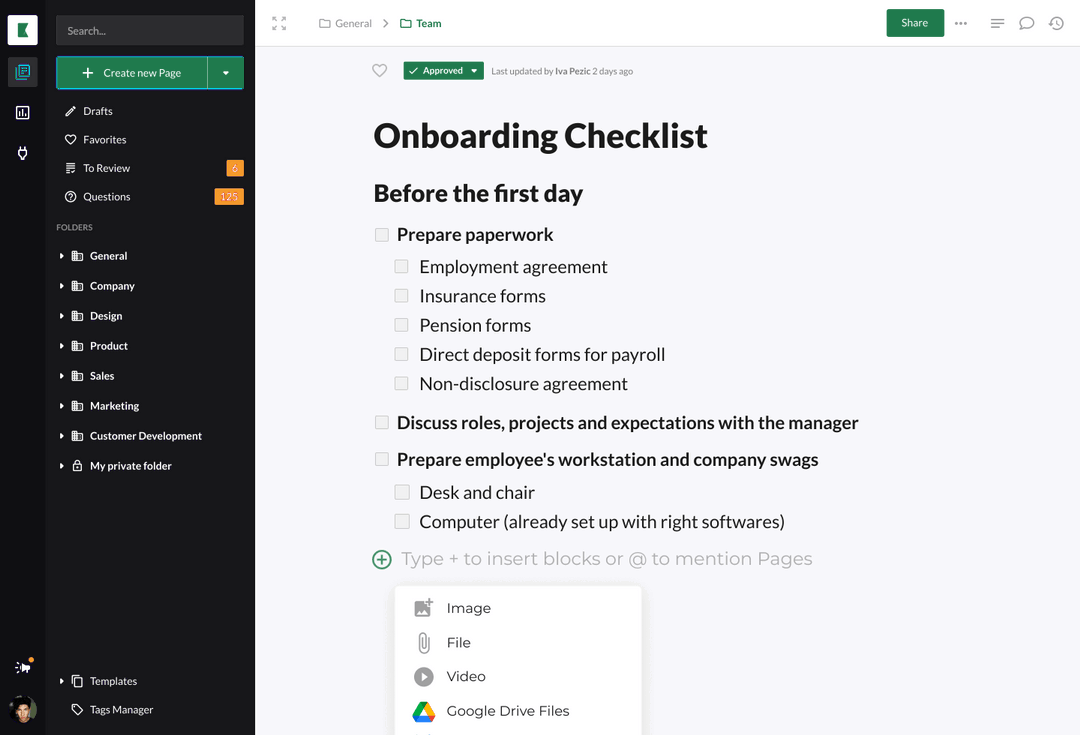
New employee expense reimbursement fails when an onboarding assistant confuses guidance with readiness. The company brain may find an expense policy, yet the new hire can still have the wrong legal-entity rules, no expense-system profile, an inactive card, an invalid reimbursement destination, or no way to repair a rejected report. The fix is a finance-owned workflow with separate states for policy selection, profile activation, card controls, substantiation, approval, and payment. The assistant explains current rules and shows safe status. Authoritative finance systems accept receipts and payment data. A small test expense proves that the route works before the employee pays for a real trip, customer meeting, or required purchase.
A correct policy answer does not prove expense readiness
An expense policy answers questions such as which categories are allowed, what evidence is required, who approves a claim, and when an employee should use a company card. It does not prove that a particular employee can submit or receive anything.
The IRS Employer's Tax Guide distinguishes employee business expense reimbursements under accountable and nonaccountable plans. That makes policy selection and substantiation material parts of the workflow in the United States. The applicable process can also depend on the worker's employer, location, employment arrangement, currency, spending category, and finance platform.
A generic company-brain answer creates several common failures:
- The employee follows a policy written for another entity or country.
- The finance platform has no active profile for the worker.
- A card record exists, but the card is not activated or has unsuitable controls.
- The employee uploads a receipt or bank detail into general chat.
- A manager approves a checklist while the expense system rejects the report.
- Finance marks a report paid, but the employee cannot receive the reimbursement.
Treat these as separate states. Never reduce them to one checkbox called expense setup complete.
Keep the company brain out of the money path
The company brain should own current guidance, safe status, and routing. It should not become the expense ledger, card processor, receipt archive, payment destination store, or final approval record.
Employee and payment information can spread through transcripts, search indexes, analytics, and support notifications. The NIST Privacy Framework frames privacy as an organizational risk that must be identified and managed. Define the purpose, destination, access rule, and retention period for every field before connecting the systems.
Use three data zones.
Searchable guidance
The knowledge layer may contain approved expense rules, category definitions, submission instructions, deadlines, named support routes, and explanations of each workflow state. Every answer should cite a current source with an owner, applicable population, and effective date.
Restricted finance records
Receipts, payment details, card numbers, transaction data, report contents, tax treatment, and exception notes belong in authorized finance systems. Do not index them in general employee search. The company brain needs only a limited status projection.
Safe onboarding status
The onboarding plan may expose values such as policy-assigned, profile-active, card-not-required, test-report-rejected, or reimbursement-verified. It may also show the accountable owner and next action. It should not include receipt images, account details, card credentials, or the reason behind a sensitive finance review.
Model expense readiness as a state machine
A state machine prevents a downstream success from hiding an upstream failure. It also gives the assistant an honest response when a source is unavailable.
employee_id: emp-4821
workflow: expense-readiness
entity: us-parent
worker_type: employee
policy_version: expense-us-2026-07
policy_state: acknowledged
expense_profile: active
reimbursement_destination: verified-by-finance-system
card_requirement: required
card_state: active
spending_controls: accepted
training_state: complete
test_report: approved
payment_verification: confirmed
workflow_state: ready
last_authoritative_check: 2026-08-27T11:15:00Z
restricted_finance_data_present: false
The company brain should receive this narrow projection from an orchestration service. It should not assemble the state by reading task labels from chat or guessing from elapsed time.
Use explicit terminal states:
blocked-policywhen no applicable policy can be selected;blocked-profilewhen the finance system rejects or cannot find the employee;blocked-cardwhen a required card is not usable;test-requiredwhen setup exists but has not been exercised;exception-openwhen finance must repair a rejected state;readyonly when every required control and the test path pass;unavailablewhen the authoritative source cannot be checked.
If a card is not required, record card_requirement: not-required instead of treating a missing card as success. Absence and inapplicability are different facts.
Build the workflow in a strict sequence
Start from the authoritative joiner event
Trigger setup from the current employee identity and lifecycle state, not from a recruiter message or a manager's copied checklist. Microsoft Entra lifecycle workflows documents joiner automation based on a user entering the scope of needing access. Use the same principle for finance onboarding.
The event should provide only the attributes required to select and create the workflow, such as employee identifier, employing entity, country, worker type, department, manager, cost center, start date, and card requirement. Assign an owner for missing or contradictory values. Do not let the model fill them in.
Make the handler idempotent. A corrected start date or retried event must update the same workflow rather than create a second expense profile or card request.
Select one applicable policy version
Build a deterministic policy resolver. Match the employee's current attributes against approved scope rules. Return one policy identifier, version, owner, and effective date.
If two policies match, stop and route the conflict to finance. If none matches, return blocked-policy. The assistant can explain that finance must resolve the scope, but it must not choose the rule that sounds most relevant.
Show the employee the selected guidance and record acknowledgment only when the approved system receives it. A chat response such as "Got it" is not evidence of acknowledgment unless the organization has deliberately designed it as the authoritative mechanism.
Activate the expense-system profile
Create or enable the employee in the expense platform with the right entity, manager, approval chain, cost center, currency, and reimbursement method. The GitLab expense reimbursement handbook provides a practitioner example of entity-specific submission routes, policy compliance checks, missing-information handling, reimbursement timelines, cards, and exceptions. It shows why a single global instruction is not enough.
Wait for the finance platform's accepted state. A successful outbound API request only proves delivery, not activation. Store the external profile reference and source timestamp. If the platform rejects the employee, expose a safe reason code such as missing-cost-center or manager-not-active, then assign the repair to finance or People Operations.
Collect reimbursement destination details directly in the authorized finance or payroll interface. The company brain may link to that step and report whether verification is pending. It should never ask the employee to paste banking details into chat.
Issue a card only when policy requires one
Card creation and card usability are separate events. Stripe Issuing's card documentation covers cardholders, physical and virtual cards, card management, spending controls, and lifecycle controls. Use those concepts even if the organization uses another issuer.
Record the cardholder acceptance, card type, activation state, spending category limits, amount limits, geographic limits when applicable, and owner. Do not expose full card data in onboarding status. If a physical card is delayed, define whether a controlled virtual card or reimbursement route is allowed. Do not improvise a fallback through the assistant.
Test both allowed and denied behavior. A card that authorizes everything is not ready merely because one transaction succeeds. A card that declines every permitted category is also not ready.
Teach substantiation in the actual tool
Explain what evidence the selected policy requires, when the report is due, how to classify the expense, and who approves it. Then let the employee practice in the same system used for real reports.
The GitLab onboarding handbook demonstrates the operational value of explicit onboarding tasks, owners, notifications, and support routes. Apply that structure to expense setup. Give each step one owner and a verifiable result.
Use synthetic evidence or a finance-approved low-risk purchase for the test. Do not fabricate a receipt that could enter the accounting record as a real transaction. Mark training data clearly and remove it according to the test-data procedure.
Verify approval and reimbursement separately
A report can be submitted, approved, exported, paid, and received. These are different events.
For a reimbursement test, require the expense platform to accept the report, the correct approver to act, finance to accept the accounting state, and the employee to confirm that the payment route works. If sending money is not appropriate for a test, finance should define an equivalent verification that exercises every integration up to the final transfer and separately validates the destination.
The company brain may say ready only after the approved verification rule passes. Until then, it should name the pending state and owner.
Follow one employee through the workflow
A new customer success manager joins the U.S. entity. The lifecycle event creates one expense-readiness workflow. The policy resolver assigns the current U.S. employee expense policy and identifies that the role requires a controlled company card for travel.
The employee reads the cited policy in the company brain, then acknowledges it through the approved workflow. The expense platform initially rejects the profile because the cost center is missing. The assistant shows blocked-profile, names People Operations as the owner, and links to the support route. It does not ask the employee to choose a cost center.
After the HR record is corrected, the same workflow retries. The finance platform activates the profile. The card program creates a virtual card with the approved limits, but a permitted travel test is declined because the merchant category control is wrong. The state becomes blocked-card, and the card administrator fixes the control.
The employee submits a finance-approved test expense with the required evidence. The manager approves it, finance accepts it, and the verification procedure confirms the reimbursement destination. Only then does the workflow become ready. Policy, access, controls, substantiation, approval, and payment routing have now been tested. Reading an onboarding page would have proved none of them.
Handle failures without guessing
Design failure responses before launch.
If employee attributes conflict, freeze policy selection and route the issue to People Operations and finance. Do not use the more recent timestamp as proof that one source is correct.
If the expense platform is unavailable, return unavailable with the last successful check time and a staffed finance contact. Cached readiness is not current readiness.
If a profile request times out, retry with the same idempotency key. Reconcile against the finance system before sending another create request.
If a card shipment or activation fails, keep the employee on the approved fallback route. A generic suggestion to use a personal card may violate policy or create financial hardship.
If the test report is rejected, preserve the reason code in the finance system, show the employee a safe correction instruction, and keep an accountable owner. Do not mark training complete while the practical test remains broken.
If private finance data reaches chat, stop indexing and secondary processing where possible, restrict the conversation, and route cleanup through the organization's privacy and incident process. Do not copy the sensitive content into a second ticket.
If the employee changes entity, manager, role, or cost center before starting, rerun policy and approval resolution. Revoke or update obsolete card controls and profile assignments rather than layering new access over old access.
Verify the full path before launch
Use synthetic employees for every supported entity and worker type. Test successful and failed routes.
Require evidence that:
- exactly one current policy is selected for each supported employee;
- ambiguous or missing attributes block the workflow;
- duplicate joiner events do not create duplicate profiles or cards;
- receipts and payment details never enter company-brain search or analytics;
- the finance system, not a checklist, confirms profile activation;
- required card controls allow approved tests and deny prohibited tests;
- card-not-required is recorded explicitly;
- acknowledgment uses the approved evidence mechanism;
- rejected reports show a safe next action and accountable owner;
- approval comes from the current authorized approver;
- payment-destination verification is distinct from report approval;
- source outages produce
unavailable, not a cached success; - entity or role changes rerun the affected decisions;
- only the defined end-to-end test can produce
ready.
Kipwise's employee onboarding solution provides product context for assigned reading, searchable company guidance, and onboarding progress. Use those capabilities for current policy and safe orchestration status. Keep receipt evidence, card data, account details, approval records, and payment execution in their authoritative systems.
Start with one entity and one test expense
Choose one employing entity, one worker type, one expense platform, and one card rule. Map the current policy owner, required attributes, approval path, exception owner, reimbursement verification rule, and employee support route. Build the limited status projection only after finance signs off on the state definitions.
Then run one synthetic joiner through a duplicate event, a missing cost center, a card-control failure, a rejected report, a source outage, and the successful route. Release the workflow when the employee can find the right rule, submit evidence privately, repair an exception, and prove the reimbursement path works. Do not release it because the assistant can summarize the expense policy.
References
- IRS Employer's Tax Guide supports the U.S. treatment of employee business expense reimbursements under accountable and nonaccountable plans.
- Stripe Issuing cards documentation supports the cardholder, card management, spending-control, and lifecycle-control concepts.
- GitLab expense reimbursement handbook provides a practitioner example of entity-specific expense routes, compliance review, reimbursement timing, cards, and exception handling.
- NIST Privacy Framework supports a risk-based approach to governing and protecting personal information.
- Microsoft Entra lifecycle workflows supports lifecycle-triggered joiner tasks based on current identity attributes.
- GitLab onboarding handbook provides a practitioner example of explicit onboarding tasks, owners, notifications, and support routes.
- Kipwise employee onboarding provides product context for assigned guidance, searchable knowledge, and onboarding progress.