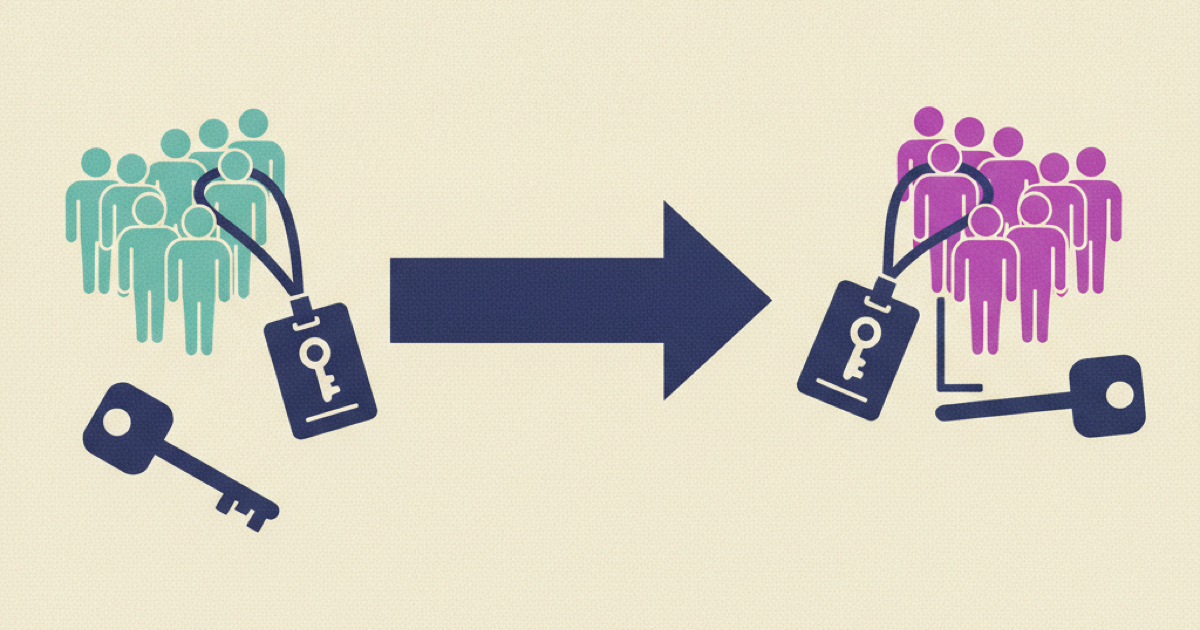
How to Onboard Employees After a Merger with an AI Company Brain

Merger employee onboarding fails when the integration team treats acquired employees like ordinary new hires. They already know how to do their jobs, but they may now face two policy libraries, duplicate tools, changed email identities, and unfamiliar approval rules. A generic orientation hides those conflicts instead of resolving them. An AI company brain can help, provided it knows which source applies, who may read it, and when a legacy instruction stops being valid. This guide shows how to build that control layer, assign only the knowledge that changed, and verify that employees can work safely before old systems and documents are retired.
Why merger onboarding is a separate workflow
A merger combines organizations faster than it combines operating knowledge. Legal ownership can change on one date while payroll, identity, security, customer support, and approval processes take months to converge. During that interval, an acquired employee may have a valid legacy procedure and a valid parent-company procedure that give different answers.
Consider an account manager from the acquired company. Before close, a discount above 15 percent required approval from a regional director. After close, the parent company requires finance review above 10 percent, but the acquired CRM and its old sales handbook remain in use for six weeks. A search assistant that simply retrieves the most similar paragraph can return the wrong threshold. A broad announcement saying that parent policies now apply does not explain which system, customer segment, or date the rule covers.
The same ambiguity affects access. An employee can receive a parent-company account while retaining a legacy identity, group membership, and document links. If the company brain cannot connect those identities, it may hide required material or retrieve documents that no longer serve a business purpose. The NIST Zero Trust Architecture supports making access decisions from current identity, resource, and policy context rather than trusting a previous affiliation.
Treat post-merger integration as a staged transition between two operating states. The goal is not to copy every legacy page into one index. The goal is to make every material answer traceable to the right source, audience, owner, and effective period while the organizations converge.
Start with an integration knowledge map
Before connecting an AI assistant, inventory the knowledge needed for the first 30 to 90 days. Limit the first pass to workflows where a wrong answer can block work, expose data, create a financial commitment, or violate a policy.
For each source, record:
- originating company and business function;
- accountable owner and reviewer;
- audience, location, role, and legal entity;
- effective date and expected retirement date;
- systems and processes it governs;
- confidentiality and retrieval permissions;
- known conflicts with the other company's material;
- migration state: legacy, transitional, target, or retired.
Do not ask the model to infer these fields from prose. Store them as controlled metadata. A policy can sound current while referring to a system that is already read-only. A page can have a recent edit date because someone fixed a typo, not because an owner approved it for the merged organization.
A compact record might look like this:
source_id: sales-discount-policy-acquired
origin: acquired_company
state: transitional
audience:
 legal_entity: acquired_subsidiary
 roles:
 - account_manager
governs:
 - legacy_crm
effective_from: 2026-08-01
retire_after: 2026-09-15
owner: revenue_integration_lead
conflicts_with:
 - parent-sales-discount-policy
This map closes a gap that ordinary knowledge-base migration leaves open. Moving files answers where content lives. It does not answer which instruction controls a decision today.
Define temporary precedence before search goes live
Conflicts are unavoidable. Write explicit precedence rules instead of asking the model to blend two policies into a reasonable summary.
A useful rule evaluates five fields in order:
- legal entity and employment relationship;
- location and regulatory scope;
- system or process still in use;
- effective date and transition milestone;
- named accountable owner.
If those fields select one source, the company brain can answer with the controlling passage and explain why it applies. If they do not, it should show the conflict and route it to the integration owner. Fluency is not resolution.
For the account manager example, the assistant might say that the legacy threshold still governs quotes entered in the acquired CRM until September 15, while the parent threshold governs quotes created in the target CRM from September 1. It should link each claim to the applicable source and identify the owner of the overlap period.
Keep precedence rules in workflow code or a governed rules table. The language model can explain the result, but it should not decide that a newer document automatically wins. A newer page can have the wrong legal or operational scope.
Map identities before merging indexes
Employees need a stable integration identity that links their legacy and target accounts without granting the union of both permission sets. Microsoft's lifecycle workflows provide a useful model for automating identity tasks from employee attributes and lifecycle events.
Build an identity map with:
- one workforce identifier;
- legacy and target account identifiers;
- current manager, role, team, location, and legal entity;
- migration wave and milestone dates;
- approved temporary access with owner and expiry;
- source groups scheduled for removal;
- target groups approved for activation.
Then apply permissions during retrieval. Microsoft's guidance on document-level access control describes patterns for filtering searchable documents by current user or group access. The important sequence is filter first, retrieve second, generate last. Hiding a citation after restricted text has reached the model is too late.
Do not combine all legacy and target groups into one large entitlement. During integration, broad access feels convenient because teams are still discovering dependencies. It also makes later cleanup difficult. Represent every cross-company exception with a purpose, approver, and expiry date.
Assign the change, not the whole handbook
Acquired employees do not need a replay of basic orientation. They need a reliable description of what remains the same, what changes now, what changes later, and what is still undecided.
Classify required knowledge into four buckets:
- Retained: The employee's existing process remains valid for a defined period.
- Changed: The parent-company rule applies now and replaces the legacy rule.
- Transitional: Both processes remain active for different systems, entities, or dates.
- Unknown: Owners have not resolved the conflict, so the employee needs a safe escalation route.
Turn those buckets into task-sized assignments. A change assignment should name the old behavior, the new behavior, the effective date, the source, and one realistic decision the employee must make. Kipwise's employee onboarding workflow provides the product context for assigned reading, searchable company knowledge, and progress tracking. In a merger, completion should focus on changed and transitional work rather than the number of pages opened.
The public GitLab onboarding handbook is a practitioner example of explicit tasks, role details, access requests, owners, buddies, and support paths. Apply that ownership discipline to integration work. Every assignment needs someone who can answer a conflict and someone who can confirm readiness.
Build a staged merger onboarding sequence
Use five stages for the workflow.
Establish the employee context
Confirm the workforce identifier, legal entity, role, manager, location, migration wave, and active systems. Stop if the HR record and identity directory disagree on a field that controls access or policy scope.
Deliver a personal change brief
Generate a brief from governed metadata, not from an unconstrained summary of both libraries. List retained, changed, transitional, and unknown items. Link every material instruction to the source the employee can open.
Grant minimum target access
Activate only the target systems needed for assigned work. Keep temporary legacy access explicit and expiring. Test the employee's real account instead of an administrator account.
Practice decisions at transition boundaries
Use scenarios that force the employee to distinguish old and new rules. Ask which system is involved, which policy applies on the given date, what approval is required, and where an unresolved conflict goes.
Confirm readiness by scope
A manager or process owner should approve a bounded scope of independent work. Readiness for one workflow does not prove readiness for every target-company process.
Handle partial integration failures
A merger workflow must assume that systems and source owners move at different speeds.
The identity match is uncertain. Do not merge accounts based only on name or email similarity. Route the record for verification and keep access at the safer boundary.
A source has no owner. Mark it unresolved. Do not let frequent retrieval turn an orphaned page into policy.
Two policies conflict. Withhold a single prescriptive answer. Show the conflicting scopes, block consequential automation, and assign a resolution owner.
The target system is not ready. Keep the approved legacy process active for a defined period. Publish the transition milestone and avoid telling employees to use a system they cannot access.
A migration date changes. Recalculate assignments, expiries, and retrieval filters from the authoritative milestone. Do not patch individual checklists by hand.
Legacy access cannot be removed. Record a time-bound exception with an owner, reason, compensating control, and review date. Treat an expired exception as a failed control.
Workflow code should enforce these states. The model may summarize the problem and help the employee find the owner, but it should not convert a failed prerequisite into apparent completion.
Verify the merged company brain end to end
Test the employee journey with real identities from each migration wave. Use both positive and negative checks.
Before declaring a workflow ready, confirm:
- the employee context matches HR and identity records;
- target documents are retrievable through the employee's account;
- restricted parent and legacy documents remain hidden;
- every answer shows an accessible source and applicable scope;
- retired material cannot appear in search or generated answers;
- transitional rules switch at the stated milestone;
- temporary cross-company access expires as designed;
- unresolved conflicts stop consequential guidance;
- scenario results show that the employee can apply the correct rule;
- a named manager or owner approves independent work.
Run a small regression set whenever a source, identity rule, or migration milestone changes. Include at least one query that used to return each retired legacy procedure. A successful target answer is not enough if the obsolete answer remains available under slightly different wording.
Measure operational outcomes rather than chat activity. Useful measures include time to approved access, unresolved policy conflicts by owner, expired exceptions, failed retrieval checks, and time from conflict discovery to governed resolution. High question volume can mean engagement, confusion, or both.
Start with one migration wave
Choose one acquired team, one high-value workflow, and one clear system transition. Build the source map, define precedence, map identities, write three change assignments, and test two boundary scenarios. Run the process manually before automating it across the company.
The first wave should produce evidence, not just a launch date. Expand to the next workflow only when identity, source scope, permissions, assignments, and manager approval agree. Merger employee onboarding works when the company brain makes change explicit and refuses to hide unresolved integration work behind a confident answer.
References
- NIST SP 800-207: Zero Trust Architecture supports access decisions based on current identity, resource, and policy context.
- Microsoft Entra lifecycle workflows supports identity tasks triggered by employee attributes and lifecycle events.
- Microsoft document-level access control supports retrieval-time filtering by current user or group access.
- Kipwise employee onboarding provides product context for assigned reading, searchable knowledge, and onboarding progress.
- GitLab's onboarding handbook provides a practitioner example of explicit tasks, owners, access requests, and support paths.
-p-1080.jpg)