AI Sales Assistant in Slack: What to Hand Off Before You Hire One
In a founder-led sales team, the sales admin usually lands on the founder. Calls end without an outcome in the CRM, follow-ups slip a week, a deal goes quiet and nobody notices until the forecast is wrong. The usual fix is to hire a sales assistant or a sales ops VA. The newer fix is to buy an "AI sales assistant".
This guide is for founders, owners, and ops generalists at Slack-first firms of about 5 to 100 people who sell through HubSpot or Pipedrive and are about to make that choice. It explains what an AI sales assistant can actually run from Slack, what your CRM already does for free, and which parts of the job should stay with a person, so you hire, buy, or do both for the right reasons.
Three different products use the same name
Search for "ai sales assistant" and you get three kinds of product on one results page. Compare them as one category and you end up comparing prices for different jobs.
The first kind is the outbound agent, often called an AI SDR or AI BDR. It researches prospects, writes first-touch emails, and books meetings. AIAgentForSales compares 13 of these vendors and lists public prices from $1 per qualified lead to "from $3,750 per month" for an autonomous AI BDR, set against a $98K to $173K fully loaded human SDR. Theos's list of the best AI sales agents, written by a vendor, compares agents that prospect and message people on social networks and WhatsApp.
The second kind is the deal copilot for reps. Sybill says it records "calls, meetings, emails, and Slack threads" to know the state of every deal, and claims to "save reps 10+ hours/week on sales admin". Ultragent watches deals, "catches the ones going quiet", and drafts the next email.
The third kind is the CRM admin agent that lives in Slack. Junior's HubSpot page describes a daily CRM briefing of overdue follow-ups and pitches it at "Founder-led sales" and small teams with "No CRM admin". Hubby says it finds stale deals and fixes bad data from Slack.
The human market splits the same way. Catalyst Outsourcing's guide to virtual sales assistants separates a sales admin assistant (CRM upkeep, follow-ups, booking, proposals), a lead generation assistant, and an appointment setter, and says the sales admin assistant "is where most teams start".
So decide which of the three products sold as an AI sales assistant you need before comparing any, because outbound AI SDRs write to strangers under your name, deal copilots serve reps on calls, and a founder-led team hiring a sales assistant usually needs the third kind, a CRM admin agent. If your real problem is that nobody books meetings, you need outbound help, from a person or an AI SDR. If your problem is that the CRM is wrong and follow-ups slip, outbound software will make it worse, because it adds more conversations to a pipeline nobody is keeping current. This is our recommendation, drawn from how these vendors and the human-staffing guide describe themselves.
Check what your CRM already does in Slack
Before paying for a third-party tool, open your CRM's own Slack app. HubSpot's knowledge base article on using Breeze Assistant in Slack, last updated 11 September 2026, says it can "search and summarize CRM records, create and update records across all objects, manage tickets, analyze your pipeline, prepare for meetings, and summarize Slack threads". HubSpot lists it as available on all products and plans. To use it, you connect the HubSpot Slack app and log in to Slack with your HubSpot user.
The same article states the limits. In channels and threads, Breeze Assistant "only responds when it is explicitly @mentioned", you must mention it "for each request", and it "does not monitor channels or threads automatically".
Check what your CRM's own Slack app already does before you buy, because HubSpot's Breeze Assistant in Slack can already search and update records when mentioned, and the part you would pay for is the scheduled, unprompted check across tools, since Breeze only answers when @mentioned and does not monitor channels. If you only want to ask "what's the status of the Acme deal?" from Slack, try the free option first. If you want something that posts Monday's list of deals with no next step, compares it with unpaid invoices, and drafts follow-ups without anyone remembering to ask, that is the gap a separate agent fills.
If you use Pipedrive, test whatever Slack app your plan includes the same way. Does it answer only when asked, or can it run a check on a schedule and across other tools?
What the sales assistant job actually involves
In a review compiled on 27 September 2026, Kipwise read public Upwork job posts that hire a person to work inside the client's own Slack. Nine of those team-chat posts had sales, CRM, or lead work in the title or role. Kipwise estimated how much of each post's task list an agent in Slack could do. The estimates ranged from 0% to 35%, with a median of 25%. These are Kipwise estimates from post text, not measurements of any team, but they make the point that most of the job stays with a person even when the admin moves.
The clearest of these posts was titled "CRM Checker / Sales Ops Assistant". It asked someone to check that every call is logged in the CRM with an outcome and next step, flag overdue touchpoints, message closers when something is missing, and send the sales manager a daily pass or fail report per closer. Its pain line was "calls that aren't logged, follow-ups that get forgotten, leads that go cold". Three others used "nothing falls through the cracks" or a close variant such as "prospects don't fall through the cracks".
A founder on Hacker News described the same load from the inside. In a comment about where a founder's time goes, they list "administrative sales tasks (chasing people for meetings, writing proposals, negotiating contracts)" and "meeting prep and follow-up" as the work that pulls them away from talking to customers. That is one person's account, but it matches the posts.
The "cannot" lists in those nine posts named WhatsApp, LinkedIn outreach, phone calls, and CRMs outside the agent's connections, such as Close, ActiveCampaign, and GoHighLevel. If your sales team lives in one of those, an agent can only cover the edges.
Sort the job description before you post it
Take the sales assistant job description you would post and sort every line into one of three columns.
| Column | Typical lines | Who runs it |
|---|---|---|
| Checks and admin | Calls with no logged outcome, deals with no next step, stale deals by owner, weekly pipeline summary, paid or failed invoices | An agent on a schedule, with your approval on writes |
| Writing that a prospect sees | Follow-up emails, recap notes, proposal drafts | An agent drafts, a person approves and sends |
| Selling and relationships | Prospecting lists, cold outreach, calls, pricing, negotiation, closing | A person |
Treat the middle column separately. A wrong CRM field annoys your team. A wrong email reaches a buyer under your name.
If the first column is most of the list, you may not need the hire yet. If the third column is most of it, you need a salesperson or an appointment setter, and no assistant, human or AI, will fix that. The Catalyst guide makes the same point from the staffing side: a sales assistant is the wrong hire when "You need someone to sell", because closing needs a salesperson.
Start the agent as a CRM checker
Start the agent as a CRM checker that posts a daily list of missing outcomes and next steps by owner, and only later let it draft anything a prospect sees, because the sales-assistant job posts in Kipwise's review describe a checker role more than a writer role. A checker's output is a list for your team to fix, so a wrong item costs a minute of someone's time rather than a prospect's trust. A few weeks of that list also tells you whether the CRM data is clean enough for the agent to write follow-ups from it later.
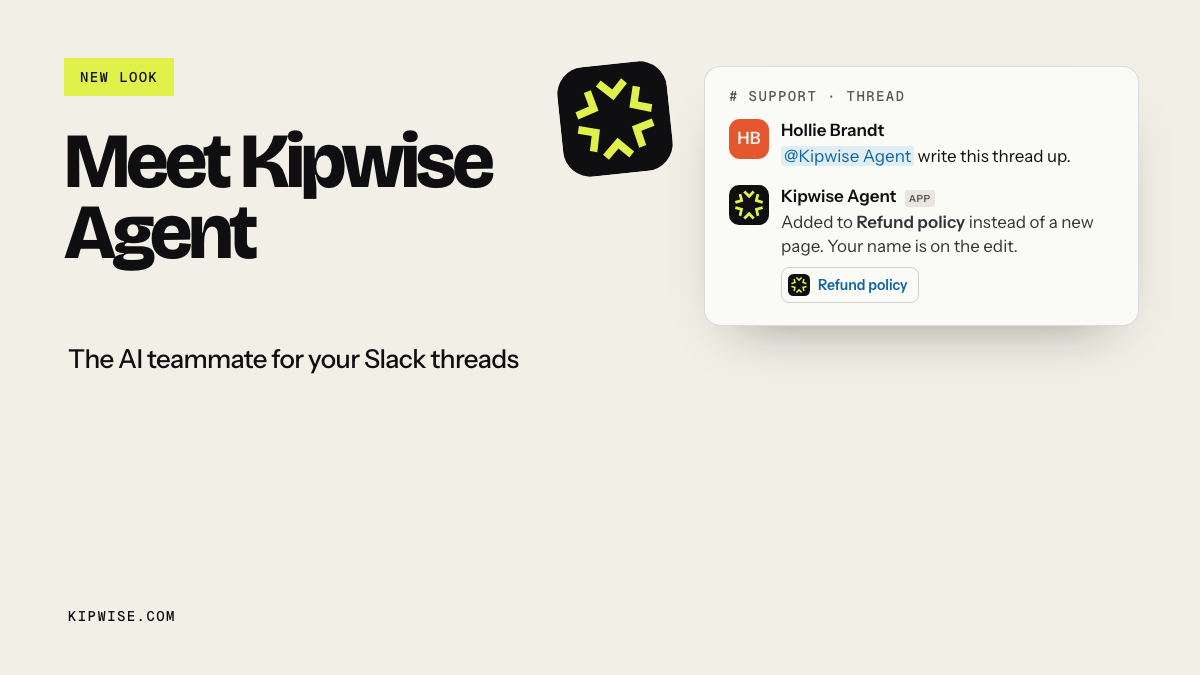
With Kipwise Agent, you mention it once in a sales-ops thread, then continue with plain replies in the same thread. With HubSpot or Pipedrive connected, it looks up people, companies, deals, leads, activities, notes, and who owns what, using your own CRM access. Ask it to run a request every weekday morning: list open deals with no next step and calls or meetings with no logged outcome, grouped by owner, with a link to each record. Creating that schedule needs your approval once, and later runs do not ask again.
When someone replies in the thread with the missing outcome, you can ask the agent to log the note, add a task, or move the deal. It can also run when a deal is created in HubSpot, and it reads the record back with your tools before acting on the notification. For the logging part of this job in more depth, see our guide to keeping your CRM clean from Slack without a data-entry VA. For first response on new leads, see keeping new leads from going cold in Slack.
Kipwise Agent works on the CRM records, inboxes, and tools you connect. If the job is finding and emailing new prospects, look at the first category instead.
Keep anything a prospect sees behind your approval
Slack's agent design guidance for developers says that when an agent acts using someone's identity, that "should always be visible and reviewable", and that an agent "shouldn't be able to read, access, or use information that the invoking user wouldn't be able to access on their own". For a sales assistant, follow-ups go out with your name on them, and pipeline data is often split by owner.
Vendors in the third category say they handle approvals. Hubby says every write action "pauses for your approval in Slack", and Ultragent says "nothing reaches a customer unless you approve it". Ask any vendor you trial to show you the approval step, not describe it.
In Kipwise Agent, a live request that changes a CRM record or posts a message first shows an Approve or Deny card. Only the person who asked can use it, and it expires after 30 minutes. Follow-up emails are written as drafts in your Gmail, and sending shows the recipient, subject, and a preview on a card first. On the Kipwise HubSpot agent page, each teammate connects their own HubSpot login, so nobody shares a token and the agent works within each rep's own HubSpot permissions.
Keep follow-ups as drafts for at least the first month. Count how many you approve without edits. If almost all go out unchanged, the CRM notes behind them are good enough to trust more.
Compare the cost honestly
The numbers in this category describe very different things, so label each one.
- A human sales admin assistant: Catalyst lists its virtual sales assistants from around $8.80 an hour. In Kipwise's broader 27 September review of Slack-based hire-a-person posts, the median Upwork hourly rate was $10, about $800 a month for 20 hours a week.
- An outbound AI SDR: AIAgentForSales's vendor-sourced range runs from $1 per qualified lead to from $3,750 a month, which is a different budget for a different job.
- A deal copilot: Sybill's "10+ hours/week" is a vendor claim for reps, not for a founder's admin.
- Kipwise Agent: $10 per user per month, with a minimum of 3 users, on the product page.
Compare an agent with the admin hours it removes, not with a salesperson's salary, because it does not sell. A commenter on Hacker News put the limit plainly: LLMs can make sales faster by automating "updating CRM, prospecting, finding contacts, drafting emails", but "in the end you still need human salespeople" to close major enterprise deals. That is one practitioner's view, and it fits the job posts.
What stays with a person
These lines in a sales assistant job description stay with a person:
- Phone calls, voicemails, and live conversations with prospects.
- LinkedIn and WhatsApp outreach, which the job posts listed as outside the agent's reach.
- Pricing, discounts, and negotiation.
- Judgment about a rep's performance. Kipwise's notes on the CRM checker post put judgment calls on closer performance outside what an agent can do.
- Work inside a CRM the agent does not connect to.
Put the repetitive admin in Slack before you hire, then hire for what is left.
An illustrative example
This example is made up to show the flow. A 12-person design agency sells through HubSpot. The founder still runs most deals, with one account manager helping. She drafts a sales assistant job post with 14 lines and sorts them. Six are checks and admin: missing call outcomes, deals with no next step, stale deals, and the Friday pipeline summary. Three are follow-up writing. Five are selling: outbound to new studios, discovery calls, and pricing.
First she tries Breeze Assistant in Slack for deal questions and finds it answers well when asked. What she still lacks is the morning list nobody has to request. She schedules a weekday Kipwise request in the sales-ops thread for missing outcomes and next steps by owner, approved once. After two weeks the list is short and the data is cleaner, so she starts asking the agent to draft follow-ups in her Gmail, which she approves one by one.
After four weeks the job post shrinks to the five selling lines and a few calls a week. She hires a part-time appointment setter instead of a full-time sales assistant.
Failure modes to plan for
- Buying an outbound AI SDR to fix an admin problem. More conversations land in a CRM nobody keeps current.
- Paying for what the CRM's Slack app already does. Test the native assistant first and buy only for the gap.
- Letting drafts go out unreviewed. Buyers notice a wrong detail faster than your team does.
- Running the agent on a shared login. Use per-rep connections so each person's access applies.
- Treating the checker list as the fix. The list only helps if someone owns each item by the end of the day.
Pilot it for four weeks
Run a short pilot before you post the job:
- Week one: sort the job description into the three columns and test your CRM's own Slack assistant on the questions you ask most.
- Week two: schedule the daily checker list in a sales-ops thread and count the items per owner each day.
- Week three: log notes and next steps from the thread with approval cards, and watch whether the list shrinks.
- Week four: let the agent draft follow-ups for approval and count how many go out unedited.
At the end, rewrite the job post with only the lines that are left. If they are mostly selling, hire a salesperson or an appointment setter. If they are calls and a few outreach channels the agent cannot reach, a part-time assistant may be enough. If very little is left, you may not need an AI sales assistant and a hire, only the agent.
Start today by pasting your draft sales assistant job description into a Slack thread and marking each line as a check, a draft, or a sale.
References
- HubSpot Knowledge Base: Use Breeze Assistant in Slack: what HubSpot's own Slack assistant can do, its requirements, and that it responds only when @mentioned and does not monitor channels.
- Slack Developer Docs: Agent design: visible, reviewable actions on a user's behalf and the invoking user's data boundaries.
- AIAgentForSales: AI BDR and AI SDR agents compared: third-party comparison of outbound agents and their public pricing.
- Theos: Best AI sales agents in 2026: an outbound agent list from the current results.
- Sybill: vendor description of a deal copilot that records calls and Slack threads, and its time-saving claim.
- Ultragent: vendor description of deal watching and approved drafts.
- Junior: AI agent for HubSpot: vendor description of a daily CRM briefing in Slack for founder-led sales.
- Hubby: vendor description of a HubSpot agent in Slack with approval on every write.
- Catalyst Outsourcing: Virtual sales assistant: types of sales assistant, when one is the wrong hire, and an hourly rate.
- Hacker News: a founder on sales admin time: practitioner account of administrative sales tasks and follow-up.
- Hacker News: what AI sales tools automate: practitioner view that AI handles CRM updates and drafts while people close.
- Kipwise Agent: product page with pricing.
- Kipwise Agent for HubSpot: each teammate connects their own HubSpot login.
- Kipwise: Keep your CRM clean from Slack without a data-entry VA: implementation guide for CRM logging.
- Kipwise: Keep new leads from going cold in Slack: implementation guide for first response on new leads.