AI Incident Response in Slack Without Losing Control
AI incident response in Slack can save the first ten minutes of a production incident, or make those minutes more dangerous. A careful setup gathers alerts, opens the right runbook, checks recent code changes, and keeps a cited timeline in one thread. A careless setup guesses at causes, leaks restricted evidence, or changes code because someone typed “fix it.” IT operations leaders need a workflow that speeds up investigation without confusing a suggestion with authorization.
The Slack thread is the coordination surface. Maintained knowledge and live systems provide the evidence. An authorized human owns every consequential action.
Why incident automation fails at the handoffs
Incident work crosses several boundaries at once. An alert starts in an observability tool. The response procedure lives in a wiki. Recent changes live in GitHub. Decisions happen in Slack. Customer communication may happen somewhere else. Manual response is slow because people copy context across those systems and repeatedly explain what changed.
Automation can reduce that work, but only if it preserves the boundaries. A bot that can read a runbook does not automatically have authority to change a repository. A person who can view an incident channel may not be allowed to open every linked document. A plausible command in a thread is not proof that the requester owns the affected service.
Google's incident-management chapter for site reliability engineering separates command, operational work, communication, and planning. That separation matters even when an agent performs part of the retrieval. The agent should support the incident roles, not collapse them into one automated actor.
The second failure is context drift. A busy thread contains hypotheses, corrections, screenshots, side conversations, and commands. If the agent treats every message as a new request, it loses the incident state. If it treats every message as an instruction, it may act on quoted text or a speculative reply.
The third failure is weak evidence. “A deployment probably caused this” sounds useful but leaves responders guessing which deployment, what changed, and whether the speaker had access to the source. Every factual incident claim needs a source link, timestamp, or clearly marked status as a hypothesis.
Give the Slack incident thread an explicit contract
A thread-native agent should join only after a teammate mentions it. After that first mention, plain replies in the same thread can continue the investigation without repeated commands. Slack's documentation on retrieving messages and conversation history provides the platform behavior needed to identify conversations, retrieve replies, and maintain thread context.
Do not rely on the thread timestamp alone. Store a small incident record that names the workspace, channel, root message, incident identifier, current incident commander, affected service, severity, and approved tool connections. Bind every tool result and proposed action to that record.
A minimal contract can look like this:
incident_id: INC-2026-041
slack:
 workspace_id: T123
 channel_id: C456
 thread_ts: "1788923200.001200"
roles:
 incident_commander: U111
 operations_lead: U222
scope:
 services: [billing-api]
 repositories: [acme/billing]
permissions:
 runbook_read: true
 github_read: true
 github_write: approval_required
action_policy:
 read_only: automatic
 draft_change: automatic
 apply_change: named_approver
 customer_message: named_approver
The record is an implementation recommendation, not a Slack requirement. Its purpose is to stop one thread from inheriting another thread's scope or authority. If the incident moves to a new channel or bridge, create an explicit link and re-confirm the roles. Do not silently follow messages across channels.
Split investigation from consequential action
The safest useful default is broad assistance with narrow authority. Let the agent automate reversible, read-only work and prepare risky work for review.
Read-only work can include:
- Opening the current runbook and showing its owner and last review date
- Retrieving permitted alert details and recent service changes
- Searching the incident thread for decisions and unresolved questions
- Reading relevant GitHub files, commits, pull requests, and checks
- Drafting diagnostic commands without running them
- Producing a timestamped incident summary with citations
Consequential work includes merging code, changing infrastructure, modifying access, updating a customer-facing status, deleting data, or writing an official runbook. These actions need a separate approval step. The approval should name the exact action, target, expected effect, rollback condition, and approver. “Go ahead” is valid only when the agent can unambiguously bind it to one displayed action envelope.
GitHub recommends choosing only the permissions an app needs. Its guide to GitHub App permissions distinguishes access to repository resources and supports a least-privilege design. Use separate read and write capabilities where possible. Do not give the incident agent permanent write access merely because one workflow may eventually need a patch.
Slack access deserves the same treatment. The Slack OAuth authorization flow ties an installation to requested scopes. An admin should be able to explain why each scope exists, which workspace installed it, and what happens when the connection is revoked.
Run AI incident response in Slack in six stages
The following sequence closes the gap left by pages that describe incident roles, Slack bots, or permissions separately. It connects the whole thread lifecycle from the first alert to the governed runbook update.
1. Establish identity, scope, and roles
When mentioned, the agent should identify the requesting Slack user and map that identity to each connected tool. It should state the incident record it is using and list unavailable sources. It should not borrow a service account's broad visibility when the requesting user lacks access.
Ask the incident commander to confirm the affected service and severity. If no commander exists, the agent can request one, but it should not appoint itself. NIST's current incident response recommendations place incident response inside cybersecurity risk management. That is a useful reminder that ownership and preparation are controls, not administrative ceremony.
2. Build the first evidence brief
The agent should open the relevant alert, current runbook, service ownership record, and recent changes. It then posts a compact brief in the thread:
- Confirmed symptoms and timestamps
- Affected and unaffected systems
- Current runbook and owner
- Recent changes with direct links
- Missing evidence or denied access
- Working hypotheses, labeled as hypotheses
- The next reversible diagnostic step
Measure the time from the initial mention to this brief. That number is more useful than counting bot messages. It shows whether the workflow reduces manual search and copying.
3. Keep a claim ledger
Every material statement should enter one of four states: confirmed, contradicted, hypothesis, or unknown. A confirmed statement carries a source and observation time. A contradicted statement remains visible with the correcting evidence. A hypothesis names the test that could confirm or reject it. Unknown means the required source is missing, inaccessible, or inconclusive.
This ledger prevents the thread from turning early guesses into accepted history. It also lets a new responder catch up without reading hundreds of messages. The agent should refuse to upgrade a hypothesis merely because several people repeated it.
4. Propose tests before fixes
Use the current evidence to propose the smallest diagnostic step that can separate competing explanations. Show the command or query, required permission, expected signals, and risk. If execution is read-only and within policy, the agent may run it. Otherwise, it should wait for the named operator.
Suppose checkout errors rose after a billing deployment. The agent finds a schema migration in GitHub and a runbook warning about connection-pool exhaustion. It should not declare the migration responsible. It can propose checking pool saturation and comparing errors before and after the deployment. The result then updates the claim ledger.
5. Put changes inside an approval envelope
Once evidence supports a mitigation, render the full action for review. Include the repository or system, exact change, approver, preconditions, validation check, and rollback trigger. Keep discussion in the same thread, but require an explicit approval event from a mapped identity.
A safe envelope might say: “Prepare a revert pull request for commit abc123; do not merge. Validate the staging health check and attach results. The incident commander must approve merge after the service owner confirms no dependent migration.” The agent can draft the pull request and evidence. It cannot infer merge approval from urgency.
6. Close the operational and knowledge loops
At resolution, the agent should draft a timeline from the claim ledger and thread decisions. The incident commander corrects it before the record becomes final. The closeout should identify the trigger, impact, mitigation, recovery evidence, unresolved risks, and owners.
Atlassian's incident response guide describes a lifecycle that includes detection, response, recovery, and learning. The learning step should produce owned work, not a generic promise to improve documentation. If the runbook was stale, draft a specific update in Kipwise, link the incident evidence, assign the source owner, and require review before publishing it.
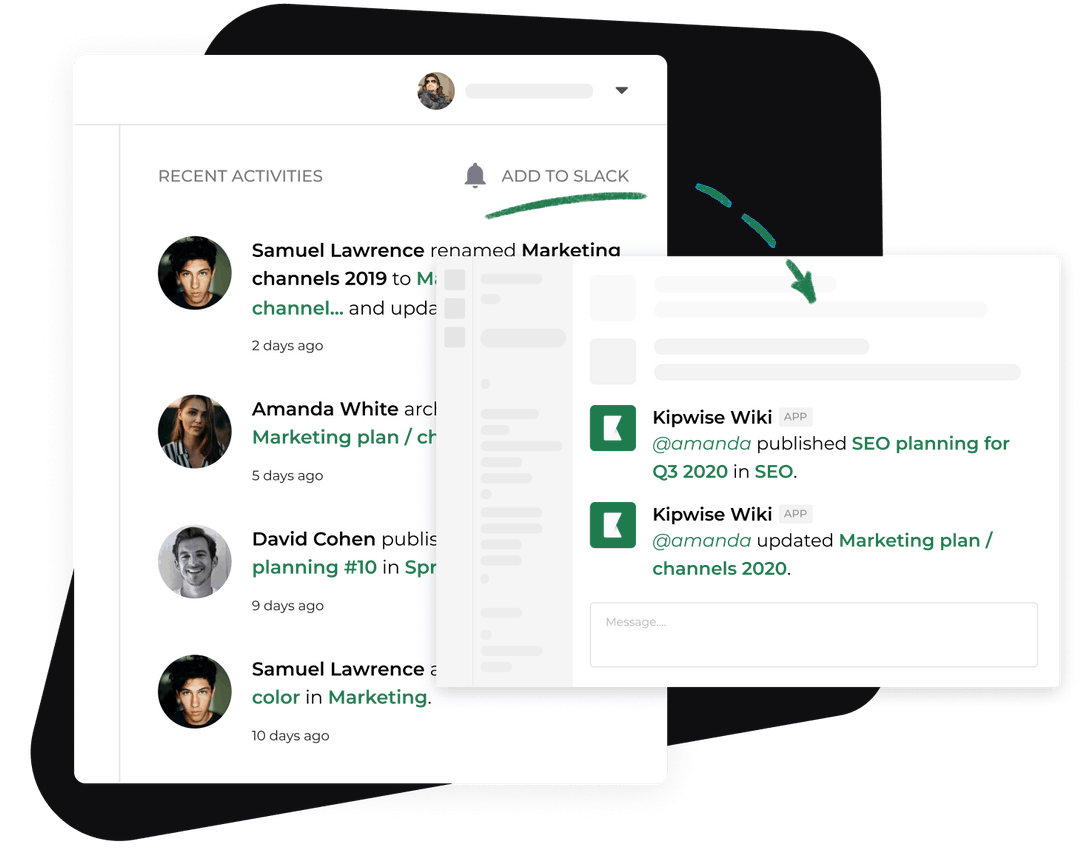
A Slack company wiki provides the product path for finding and sharing maintained knowledge from Slack. The agent extends that path by gathering cited evidence in the thread, preparing the update, and leaving publication with the responsible owner.
Handle predictable failure modes
If a connector fails, say which source is unavailable and stop claims that depend on it. Cached evidence should display its capture time. Do not quietly substitute an older runbook or another user's access.
If identity mapping fails, keep the agent read-only or refuse the tool call. A Slack display name is not a durable authorization key. If a requester asks for a write outside the incident scope, open a separate approval flow rather than expanding the current incident record.
If the thread splits, preserve one canonical decision log. Side threads may gather evidence, but their conclusions should return to the main incident thread with links. If two people issue conflicting instructions, defer to the recorded incident commander or require role resolution.
If the model cannot support an answer, it should state what it opened, what remains unknown, and the next source or person needed. Refusal is useful when it preserves the investigation path.
If the agent posts restricted material, stop further distribution, preserve the event through the approved security process, revoke or narrow the faulty connection, and test the permission path before resuming. Editing one Slack message does not repair the underlying exposure.
Verify the workflow before trusting it in production
Test the system with a simulated incident and seeded traps. Include a stale runbook, a denied repository, a misleading early hypothesis, a quoted destructive command, a connector timeout, and an approval from the wrong user.
The workflow passes only if it:
- Keeps all replies bound to the correct incident thread
- Uses the requesting user's permitted views where applicable
- Cites every confirmed material claim
- Labels hypotheses and preserves corrections
- Refuses to guess when a source is missing
- Keeps repository and customer-visible writes behind explicit approval
- Rejects approval from an unmapped or unauthorized identity
- Shows stale and failed sources plainly
- Produces a chronological timeline that responders can correct
- Turns a runbook gap into assigned, reviewable knowledge work
Track median time to the first evidence brief, manual tool switches per incident, percentage of confirmed claims with direct evidence, approval-policy violations, stale-source detections, and time to assign follow-up work. Do not reward the agent for message volume or for closing an incident it did not control.
Start with one service and one incident type. Connect its runbook and repository with read-only access, define the action envelope, and run the simulated failure set. Enable a write capability only after the negative tests prove that the wrong thread, wrong user, and vague approval cannot trigger it.
References
- Google SRE incident management supports explicit incident roles, coordinated operational work, communication, and control.
- Slack message retrieval documentation supports conversation and thread-aware message retrieval.
- GitHub App permission guidance supports least-privilege repository access.
- Slack OAuth documentation supports scoped application installation and authorization.
- NIST SP 800-61 Rev. 3 supports integrating incident response with cybersecurity risk management.
- Atlassian incident response guide supports the incident lifecycle from detection through learning.
- Kipwise Slack company wiki provides product context for finding and sharing maintained knowledge inside Slack.
-p-1080.jpg)