How to Onboard Contractors Without Employee-Level Company Brain Access
Contractor onboarding fails when a company copies its employee checklist. The contractor gets too much internal knowledge, receives irrelevant HR tasks, or keeps access after the engagement ends. The opposite approach also fails: withholding useful context forces the contractor to interrupt employees for every decision. A safer company brain gives the contractor a sponsored identity, project-scoped sources, an accountable owner, and an expiry date. It also proves access removal when the work closes. This guide provides the data model, sequence, decision rules, failure handling, and verification checks needed to build that workflow.
Why the employee workflow is the wrong starting point
An employee onboarding plan assumes a continuing employment relationship. It commonly includes payroll, benefits, leave, career development, broad internal directories, and knowledge that becomes useful over time. Employee and contractor onboarding need different playbooks: a contractor usually needs a narrower set of deliverables, systems, contacts, and operating rules for a defined engagement.
Worker status changes the control model. The IRS explains that worker classification depends on behavioral control, financial control, and the type of relationship. The U.S. Department of Labor also warns that misclassification can deny workers protections and create legal consequences. A company brain should not classify a worker. It should consume an approved worker type from the accountable legal, procurement, or People Operations process and stop if that state is missing or disputed.
Once classification is approved, three onboarding failures remain common.
First, an employee template may grant broad knowledge by default. A contractor assigned to a website migration does not need compensation guidance, customer escalation records, acquisition plans, or every engineering channel. Search makes overexposure harder to notice because one broad entitlement can surface material from many connected repositories.
Second, a generic checklist confuses completion. Signing a contract does not prove that a repository invitation worked. An identity marked active does not prove that the contractor can open the current project brief. A company brain should report each state separately rather than compressing them into a single green check.
Third, expiry is often treated as cleanup instead of part of onboarding. If no sponsor, end date, or extension process exists at the start, nobody owns the access decision when the engagement changes.
Define the contractor onboarding contract
The workflow needs one small authoritative record. Do not copy the full contract, tax record, rate, bank information, or identity document into the company brain. Store only the attributes needed to control onboarding and access.
engagement_id: ctr_2026_041
worker_type: independent_contractor
classification_state: approved
classification_owner: people_ops_17
sponsor: project_owner_42
project: website_migration
start_at: 2026-09-14
end_at: 2026-12-18
knowledge_scope:
 - project_website_migration
 - engineering_delivery_standards
systems:
 - issue_tracker
 - source_repository
 - project_chat_channel
employee_tasks_excluded:
 - benefits_enrollment
 - payroll_setup
 - employee_performance_review
access_review_at: 2026-10-30
closure_state: pending
Treat each field as a control, not decoration.
classification_state must come from an accountable process. The onboarding automation may read it, but it must not infer it from a contract title or manager request.
sponsor is the person responsible for the business need, scope, extension, and closure. A service desk can execute access changes, but it should not decide whether an engagement still requires access.
knowledge_scope is an allowlist. Map each scope to approved repositories, folders, spaces, or document labels. Do not implement it as a list of topics that the model is merely told to avoid.
end_at is required before access is issued. If the engagement has no known end date, require a short review date instead of granting indefinite non-employee access.
employee_tasks_excluded prevents a shared onboarding engine from quietly adding employee-only workflows. Keep the exclusion explicit so a later template change does not reintroduce benefits, payroll, performance, or private people records.
Build the workflow in seven steps
1. Accept only an approved engagement event
Start from the procurement, vendor management, or People Operations system that owns the engagement. Require a stable engagement ID, approved worker type, sponsor, start date, end or review date, and project code.
Reject a chat message such as "Please onboard Alex as a contractor" as an authorization event. It can open a request, but it cannot activate access. If classification is pending, show the sponsor what is missing and route the record to the accountable owner.
2. Create a sponsored non-employee identity
Create an identity that is visibly distinct from an employee identity. Record the sponsor and expiry in the identity system. Microsoft's lifecycle workflow model demonstrates how identity tasks can follow attributes and time-based events. The exact implementation will vary, but the control principle is stable: access must follow current lifecycle state rather than an old ticket.
Do not reuse a personal account, an employee's credentials, or a shared project login. The identity must support individual authentication, revocation, and an audit trail.
3. Translate project scope into enforceable access
Build access packages from resources, not job titles. A website migration package might include one project space, selected engineering standards, one source repository, one issue board, and one chat channel. It should not inherit an employee engineering group.
NIST's Zero Trust Architecture says access decisions should use current identity, resource, and policy context. Apply that principle before retrieval. Filter the searchable corpus by the contractor's effective entitlements, then retrieve sources, then generate an answer. A prompt that says "do not reveal confidential information" is not an access control.
For each resource, record:
- the business purpose;
- the access package or group that grants it;
- the approving owner;
- the start and expiry time;
- whether download, export, or write access is necessary;
- the negative test that proves unrelated material is hidden.
4. Assign contractor-specific knowledge
The first knowledge package should answer the contractor's actual delivery questions: project outcome, scope boundaries, decision owner, current plan, working cadence, approved tools, security requirements, escalation path, and definition of done.
The GitLab onboarding handbook uses explicit tasks, owners, access requests, and support paths. Borrow that structure without copying employee-only content. The company brain can assign and surface approved material, while the sponsor remains responsible for project decisions.
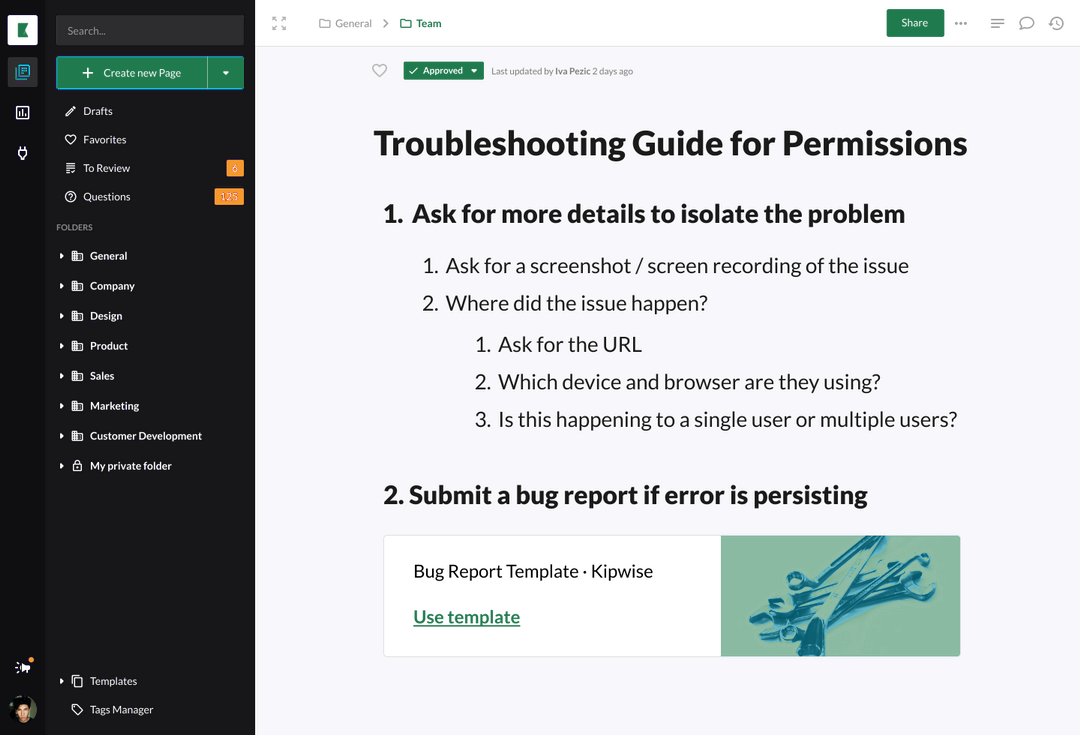
Kipwise's employee onboarding workflow shows the product pattern of assigned knowledge, searchable company information, and progress tracking. For contractors, search and assignments must operate only over approved project sources.
Require a source owner and review date for every assigned page. Contractors are especially vulnerable to stale project context because they may not know which informal channel corrected an old document.
5. Verify access with positive and negative tests
A successful invitation is not enough. Run a short acceptance test with the contractor.
Positive tests prove that required work is possible:
- sign in with the contractor identity;
- open the current project brief;
- retrieve the delivery standard needed for the first task;
- create or update a permitted project item;
- contact the sponsor or named support route.
Negative tests prove that the boundary holds:
- search for an employee-only benefits topic and receive no restricted result;
- request an unrelated customer record and receive no result;
- attempt to open a broader team folder and receive a denial;
- confirm that the assistant does not summarize inaccessible source snippets;
- verify that no employee payroll, leave, or performance task was assigned.
Record the test result and timestamp, not private chat content. If a negative test fails, suspend the affected package, investigate the source entitlement, and rerun the full boundary test before release.
6. Review changes during the engagement
Contractor access drifts when project scope, sponsor, repository, or end date changes. Re-evaluate the access package on each authoritative change event and at the scheduled review date.
Use simple decision rules:
- A new task within the approved project may use the existing package.
- A new repository, customer, environment, or business unit requires a new owner approval.
- A sponsor change requires the new sponsor to accept ownership.
- An end-date extension requires confirmation before expiry, not after access breaks.
- A classification dispute freezes automation and routes to the accountable human process.
- A dormant account does not prove the engagement ended, but it should trigger sponsor review.
The company brain may explain status and collect a request. It should not grant broader access because the contractor says the work now requires it.
7. Close the engagement and prove removal
At the end time, stop new sessions first. Revoke project groups, application roles, repository access, tokens, and shared secrets tied to the contractor identity. Transfer owned project artifacts to the sponsor. Preserve records according to the applicable policy, but remove the contractor from active search and collaboration scopes.
Closure should produce evidence for every resource:
engagement_id -> resource -> expected_state -> observed_state -> checked_at -> ownerDo not mark closure complete because one identity account is disabled. Connected applications may retain independent sessions, invitations, API tokens, or repository deploy keys. Completion means every item in the original and amended access manifest reached its expected closed state, or an exception has a named owner and deadline.
Handle the failures that automation cannot hide
A contractor onboarding system should fail closed without becoming opaque.
If the classification record is missing, do not guess. Keep access pending and tell the sponsor which accountable team owns the decision.
If the identity exists but a required application fails, preserve the successful states, assign the failed resource to its technical owner, and show the contractor a safe status. Do not repeatedly recreate the identity or broaden access as a workaround.
If the company brain returns an inaccessible document title or snippet, treat it as an access incident. Suspend the affected retrieval source, preserve the query and entitlement evidence, correct the filter, and test adjacent scopes.
If the sponsor leaves, pause extensions and route ownership to the sponsor's manager or project governance owner. An orphaned engagement should never renew itself.
If the end-date event is delayed, the identity system's recorded expiry should still stop access. Reconcile the source system afterward. A downstream expiry is a safety control, not a replacement for fixing the lifecycle feed.
If the contractor needs emergency access, create a separate time-limited exception with a reason, approver, resources, expiry, and post-use review. Do not modify the standard contractor package until nobody remembers why it became broader.
Verify the workflow before using it
Run one synthetic engagement through the full lifecycle before onboarding a real contractor. Use a test identity with no employee memberships and a project corpus containing both permitted and deliberately restricted documents.
The release checklist should answer yes to every item:
- Does activation require an approved worker type and accountable sponsor?
- Is the identity distinct, individually authenticated, and time bounded?
- Are company brain results filtered by enforceable resource permissions before generation?
- Are employee-only tasks explicitly excluded?
- Can the contractor complete a realistic first project task?
- Do negative searches hide unrelated employee and customer knowledge?
- Does a scope change require the correct owner?
- Does expiry stop sign-in and connected application access?
- Does closure reconcile every resource in the access manifest?
- Can an auditor trace each exception to an owner and deadline?
Then repeat three failure tests: remove the sponsor, delay the lifecycle event, and break one downstream revocation. The workflow passes only if it exposes each problem, contains access, and assigns recovery without claiming completion.
Start with one project package
Do not launch with a universal contractor template. Choose one recurring engagement type, such as a design contractor working in one project space. List the minimum sources and tools needed for a real first task, map those resources to enforceable permissions, add the sponsor and expiry controls, and run both positive and negative tests. Once closure proves that every grant can be removed, reuse the pattern for the next contractor type. That sequence makes contractor onboarding useful without turning non-employee access into a weaker copy of employee onboarding.
References
- IRS guidance on independent contractors and employees supports the classification boundary and the rule against automated inference.
- U.S. Department of Labor misclassification guidance supports the need for an accountable worker-status process.
- Microsoft Entra lifecycle workflows supports attribute-driven and time-based identity tasks.
- NIST SP 800-207 Zero Trust Architecture supports identity, resource, and policy-aware access decisions.
- GitLab's onboarding handbook supports explicit tasks, owners, access requests, and support paths.
- Kipwise employee onboarding supports assigned knowledge, searchable company information, and progress tracking as the product context.