RFP response for a small firm: a bid or no-bid rule, one owner per question and a Slack thread that drafts from past answers

To run an RFP response without a proposal team, decide bid or no-bid with five written questions before you write a word, put exactly one named owner on every question, and draft each answer only from responses you have already sent, with the source file named and a person approving every claim. Enrich Labs reports that Loopio's 2026 survey puts small and mid-sized businesses at about 27 hours per response, and for a firm of 10 to 50 people most of those hours belong to one person.
That person is usually the founder, who is also the only one who knows the real answer to the security and delivery questions. The usual failure is quiet. The last response gets copied, nobody decides up front whether the bid is worth the days, and a stale claim about a certification, a headcount or a delivery date goes out under the firm's name. The payoff of the process below is fewer bids you should not have started, answers that name where they came from, and the owner's hours spent only on questions nobody else can answer.
This guide covers private-sector RFPs and customer security questionnaires. Federal bids add their own steps: the SBA says you need a Unique Entity Identifier through SAM registration before you can bid on government proposals, which is outside what follows.
Should you answer this RFP at all?
Answer only when five yes or no questions come back yes, and write the verdict in the thread before anyone opens the document. Most RFP guides describe a go or no-go step: G2 cites Loopio data saying 72 percent of organizations assess an RFP with a go/no-go framework, and asks about the existing relationship, the competition, available resources and the value of winning against the cost of the work.
A firm without a proposal team should use five questions, each of which a person can answer in a sentence:
| # | Question | A "no" means |
|---|---|---|
| 1 | Can we clear every must-have, such as a certification, insurance, data residency or a required security questionnaire? | Stop. Skip the scoring. |
| 2 | Do we have a relationship with this buyer, or a reason to think we are a real contender? | Stop unless the value is high. |
| 3 | Can the named people start on the buyer's date if we win? | Stop. Never bid on work you cannot deliver. |
| 4 | Does the value of winning justify the owner's hours, counted honestly? | Stop, or ask for an extension. |
| 5 | Can we submit a quality response by the deadline with real review time? | Stop, or ask the buyer about the date. |
Run the must-have gate before any scoring, because a missing certification, insurance policy or security questionnaire requirement ends the bid in ten minutes and saves the hours that scoring a bid you cannot win would cost. This is a recommendation, built on the gate structure above. The usual habit is the reverse: a team reads the whole RFP, scores the opportunity, and finds the unmet requirement last.
Dock makes the same point in plainer words: qualify every opportunity, and have the confidence to walk away from deals you are unlikely to win. Write the no-bid in the thread too. A short, polite decline keeps the door open for the next cycle, and the thread becomes the record of why.
Who owns each question?
One person owns each question, and the owner is the person who would be embarrassed if the answer were wrong. RocketDocs puts it plainly: small teams combine roles, but every question still needs exactly one owner. Their guide also recommends a requirements matrix, a tracker holding each requirement, its owner, a status and a compliance column you check before you submit.
Make that matrix a Google Sheet your whole firm can open. One row per question, with these columns:
- Question id, copied from the buyer's file so the numbering matches.
- Section, for example security, delivery, pricing or company background.
- Owner, one name and never a team.
- Due date, set backwards from the submission deadline.
- Status: open, drafted, approved or not answerable.
- Source file, the past response or policy the answer comes from.
- Review date, the day the source was last confirmed true.
The last two columns are what stop a stale claim. RocketDocs recommends giving each reusable answer an owner who is a subject matter expert and a review date, and retiring anything outdated. In a firm of 25 people the owner column will hold only a few names, for example the founder for security and pricing, the delivery lead for the approach and the timeline, and whoever runs finance for insurance and terms.
Roles in the bigger guides, such as an RFP lead, section owners and a separate reviewer, are real jobs. Zoomforth describes them, and a firm of 25 does not have the people. Collapse them honestly. The operations lead keeps the sheet and the calendar, each section has one owner, and the founder reviews every claim about certifications, security posture, headcount and delivery dates, even if the founder also wrote some of them. Say that out loud in the kickoff post so nobody assumes a review that is not happening.
Why does a small firm's response go wrong?
Three things go wrong, and each has a plain fix. The answers live in the last response, so the next response copies it with no check that it is still true. Nobody owns the question, so it sits until the founder answers it at night. And the work starts before the decision, so the hours are spent on a bid that fails the must-have gate.
Founders describe the same pain in public. On Hacker News, a founder asks how a small company handles customer security questionnaires that arrive late in a deal with 100 to 300 questions, often as an Excel file. In an older thread, a founder says clients with 100 or more staff send long assessments and that his own time is better spent elsewhere. Replies suggest saving your answers and keeping a common security practices document. These are author reports, and several replies come from people who sell tools in this space, so read them as evidence that the problem is common and not as a measurement of how common.
If the customer sends a standard security questionnaire, check which version it is. The Cloud Security Alliance publishes CAIQ v3.1 as a set of Yes/No questions on the security controls of cloud services, and its page says that version is no longer accepted by the STAR Registry and points to CAIQ v4. If a buyer sends the old version, answer it as asked. A standing, current answer set, built once and reviewed on a date, is the cheapest way to meet that.
The library idea is not new. Diligio calls a maintained library of approved answers the single biggest accelerator, because it turns most of an RFP into reuse and tailor instead of writing from scratch, and it says reusing vetted answers can cut the effort by more than half. That second number is a vendor claim about its own approach, so treat it as a direction and not a promise. What the guides assume is a content platform and a proposal manager to run it. A firm with neither can still keep the library as one Sheet and a Drive folder.
Try Kipwise Agent free in Slack: mention it once in a thread and it does the repetitive work, with your permissions.
How does the Slack thread work?
One person posts the RFP in a channel such as #bids, mentions the agent once, and from there plain replies in the same thread continue the work. The Kipwise agent is an AI teammate that works inside Slack threads, and the details below follow what it can do today: it searches Google Drive and reads Docs, Sheets, Slides, PDF, Word, Excel and PowerPoint files with the asker's own Drive access, and in a Google Sheet it can read a range, add rows and update cells, each change waiting for an Approve or Deny card.
Here is a made-up example for a 22 person IT services firm, so you can see the shape. The names are invented.
- Intake. The operations lead saves the buyer's questionnaire in a shared Drive folder and posts in #bids: "New RFP from Northfield Logistics, due 28 November, file is in the Bids folder. Pull out the questions and the must-haves." The agent reads the file in Drive and replies in the thread with the questions and requirements it found.
- Decision. The owner answers the five bid or no-bid questions in the thread. The decision stays with the person. If question 1 is a no, the thread ends with a no-bid note and nothing else is built.
- Sheet. On a yes, the operations lead asks the agent to add one row per question to the response Sheet with the id, section, due date, status and source file. The agent shows an Approve card, and the operations lead approves it. Then the owner names one owner per row.
- Drafts. For each question, the question's owner asks the agent for a draft from past responses. The agent searches Drive, opens the past response and the policy file, and replies with a draft and the file it came from. Tell it to draft only from past responses it opened and to answer no past answer found when it has none.
- Approval. The owner edits or approves the draft in the thread. On Approve, the agent updates that row to approved and records the source file and the review date.
- Morning check. A scheduled request, approved once, posts every weekday morning until the due date the rows that still have no owner, no approved answer, or a source file older than its review date.
- Submission and library. A person submits the response. After it goes out, the agent adds the approved answers to the answer-library Sheet with an owner and a review date, so the next response starts with them.
The agent is instructed not to guess and not to cite what it did not open, and it prefers saying it could not find something to inventing an answer, so a draft names a file it actually read. Put the questionnaire in Drive before you start. The agent works from Drive files and does not fill in a customer's own Excel file or portal, and it never submits a response. A person copies the approved answers into the buyer's format and submits.
Per-user permissions matter here: the agent reads only what the asker can open, so a past response stored in a private folder is invisible to a colleague who asks. Check that the people who will ask can open the library, and keep sensitive past answers where the owner of that section can reach them.
What must a person still approve?
A person approves every claim that could be wrong in a way the buyer checks. Zoomforth warns that a model asked to fill in a compliance answer will produce a confident, plausible and unverified one, and recommends a named human owning each factual claim. Enrich Labs agrees and lists security or legal answers without owner sign-off among the things not to hand to AI.
Two practices make this hold up in a small firm.
Treat 'no past answer found' as the most useful line the agent writes, because those rows show where the real answer lives only in a person's head and are where the owner's hours should go. This is a recommendation. A draft that looks complete is the risky one, since it is easy to approve in a hurry. A row with no source is an honest signal that someone has to write the answer once, and that answer then goes into the library for next time. Sort the sheet by source file after the first drafting pass and give the empty rows to the founder first.
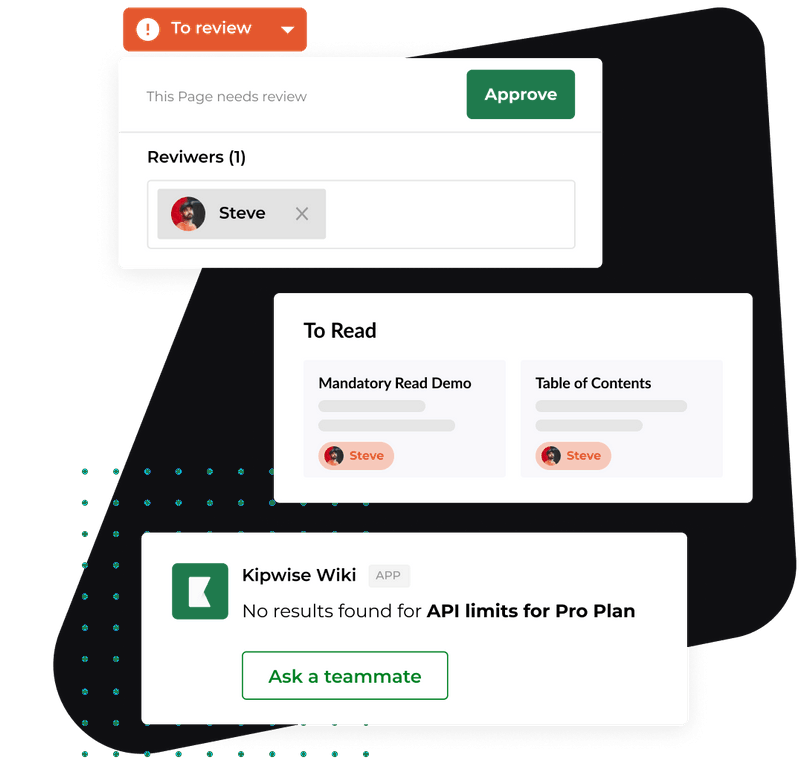
Have each question owner ask the agent for their own rows, because the Approve card can be used only by the person who asked and it expires after 30 minutes. If the operations lead asks for every draft, the cards belong to the operations lead, so the owner who knows the answer cannot approve it, and a card that sits unread for half an hour lapses and the change is not made. When the owners ask for their own rows, each approval is made by the person who is accountable for it, and an absent owner leaves one row open and visible in the morning check, not forty.
The same human-approval pattern runs through the Approve or Deny card before a change and through a plain approval request for any decision that needs a yes. If you want one accountable name per item across more than RFPs, a RACI chart is the longer version of the owner column.
What goes wrong, and what do you do?
Plan for six failures, and put the handling in the kickoff post so nobody improvises at 11 pm.
- The file is scanned or part of it does not come through. The agent reports only what it read, so compare its question list with the buyer's file. Type any missing questions into the sheet by hand and give them owners like any other row.
- The answer is in a person's head. The agent answers no past answer found. The owner writes it once, and it goes into the library.
- The source is old. A row whose source file is older than its review date is flagged by the morning check. The owner confirms or rewrites it, then updates the review date.
- The owner is away. The morning check shows the open row, and the operations lead reassigns it in the sheet. Name a backup per section before you start.
- An Approve card expires. The change is not made. Ask again, and approve within 30 minutes. Nothing is half-written, because a denied or expired card means the action did not run.
- The agent cannot reach a file. It reads only what the asker can open. Move or share the file with the asker, and do not paste confidential material into a thread to work around it.
For a questionnaire that is a portal and not a file, copy the questions into a Drive Sheet first, then run the same process. For a document that asks for a certification you do not hold, the answer is the honest one: say you do not hold it, and say what you have instead, if anything. Enrich Labs lists invented certifications, clients or metrics among the things not to produce with AI.
If your answers touch a customer's questions about the AI agent itself, the security questions a customer will ask back are a useful input. And once you win, contract management takes over where this process ends. If you are on the buying side of a questionnaire instead, vendor onboarding is the matching page.
How do you know the response process works?
Run one real RFP through it and check four things afterwards, each of which you can read off the sheet.
- Every row has one named owner and one source file or an explicit "written new" note. Count the rows with a blank owner or source. The target is zero before you submit.
- No claim went out past its review date. Filter the sheet for sources older than the review date. Each one should have been confirmed or rewritten.
- Owner hours dropped. Ask each owner how long they spent, and compare the founder's number with the last response. The first response is slower because you are building the library, so judge the second.
- The library grew. Count the answers added after submission. A response that adds no answers to the library has not made the next one faster.
Keep a short debrief after the buyer replies, win or lose, and record the outcome next to the bid or no-bid verdict. If you decline three bids in a row on the same question, change the rule or change where you look for work. The schedule-recurring-jobs guide explains how a scheduled request like the morning check runs and how to list or cancel it.
What to do next
Open your last RFP or security questionnaire response and do one thing today: create the response Sheet with the seven columns above, paste in that response's questions, and give each a single owner and a source file. That is a pilot with real content, and it will show you in an hour which answers have no source. When you are ready to run the thread, install the Kipwise agent in Slack; it is $10 per user per month with a minimum of 3 users, and a trial is available. Start with one bid, #bids as the channel, and the morning check turned on.