Manage internal knowledge efficiently with the feasibility to share content with external parties

Two ways to share internal knowledge with people outside your team
Kipwise gives you two ways to share content from your internal knowledge base with people outside your team. Use a public knowledge base for answers that many customers need, and a public link for one page or block meant for a specific client or group. We recommend keeping everything you publish in its own top-level folder, because ticking a folder’s public checkbox publishes every page inside it, and sending each recipient a separately named link, because each link has its own view count.
- Create a customer facing public knowledge base
- Use a trackable public link to share a particular piece of content with external parties
Analytics cover both, so you can see how external content performs and keep improving what you share.
Create a client facing public knowledge base
A public knowledge base lets customers find answers to common questions themselves, and you no longer manage documentation on two platforms.
Enable the public knowledge base option under Settings, then choose which content to include.
To enable your public knowledge base,
- Click on your avatar on the sidebar to go to Settings
- Go to Public Site
- Click Enable Public Site
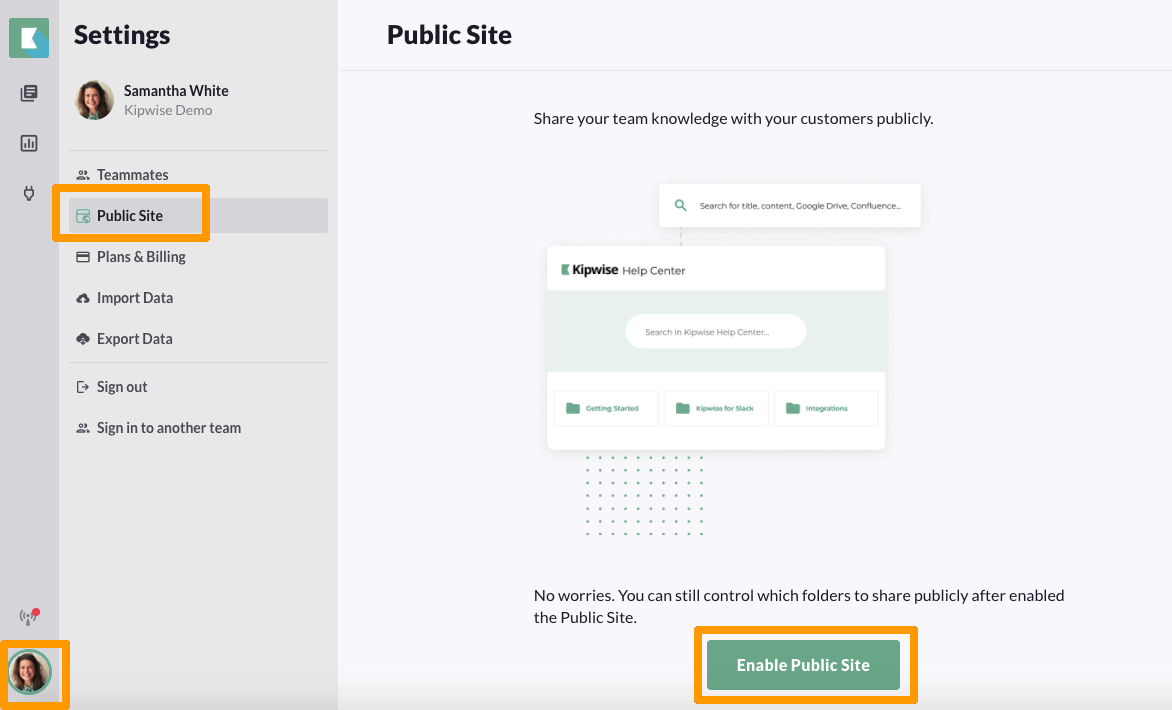
Once the public knowledge base is enabled, you can customize the look and feel to fit your company branding.
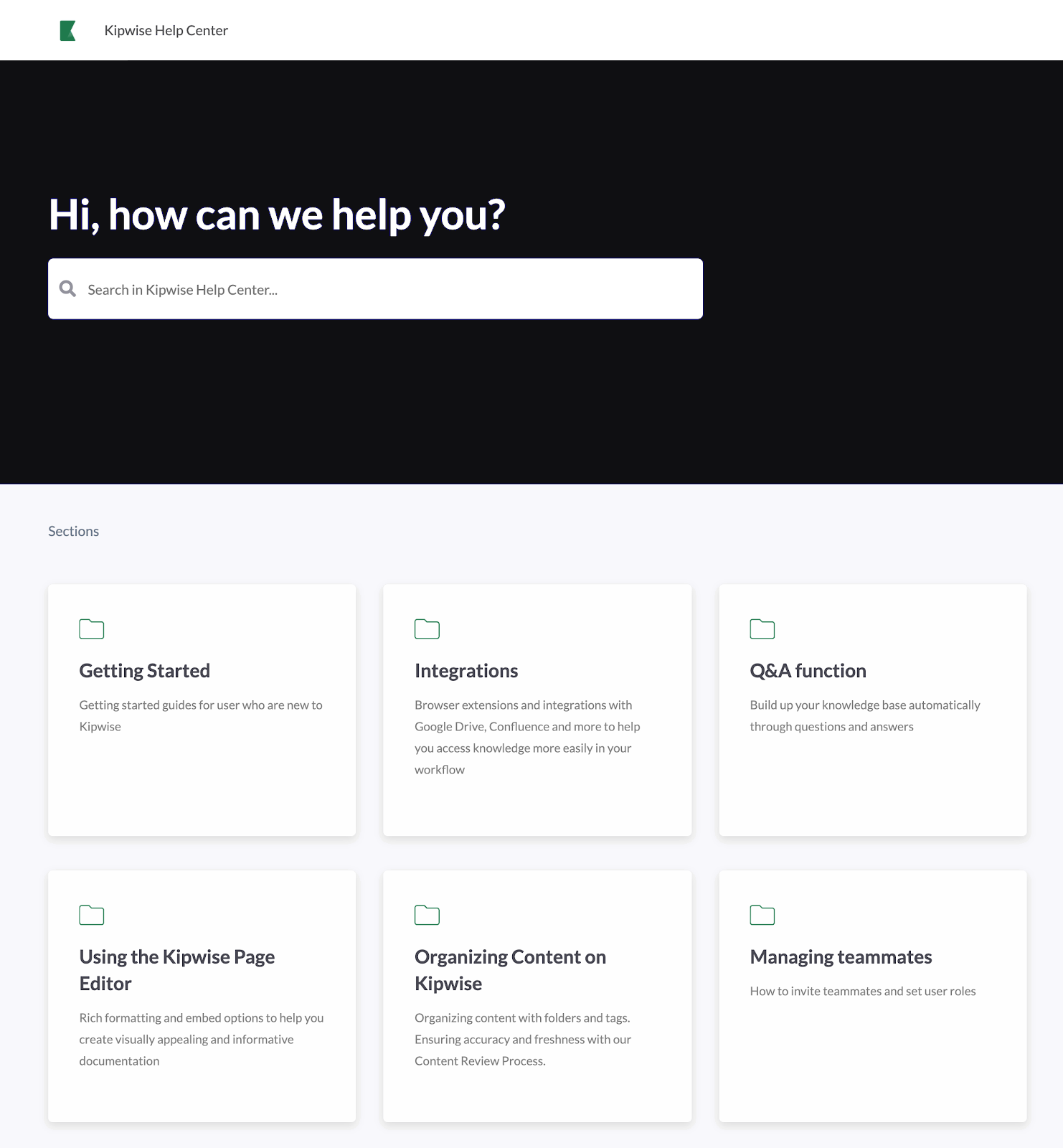
The homepage of your public knowledge base lists the top-level folders that you have set to be viewable by the public.
To control which folders you include in your public knowledge base, go to the Permissions settings for the top folder that you’d like to include, then check the checkbox “Show this folder and all the content inside on the Public Site”.

Publish from a folder made for it. That checkbox applies to the whole folder, so every page inside becomes part of the public site. Create a top-level folder for customer-facing articles, such as a Help Center folder, write the public articles there directly, and keep internal drafts, notes and support playbooks in other folders. Before you tick the box on an existing folder, open it and check every page inside.
Use Trackable Link to share a single piece of content with external parties
If a single piece of content is meant for one client or client group, share it with a trackable link instead of putting it in your public knowledge base. You can create a shareable link for a specific Kipwise Page or embedded block (for example a PDF or Google Drive slides), and you can see how many times it has been viewed.
To share an entire Kipwise Page, click the Share button on the Page, then select Trackable Public Links…

To share only an embedded block inside a Kipwise Page, mouse over the block and click the Trackable Public Link icon at the end.

Name your Trackable Public Link so you can identify it later when you view the analytics.

Then copy the link under Public link and share it with your prospects or customers. To view the analytics afterwards, go back to the Page, click the Share button and select Trackable Public Links…

Send one named link per recipient. If you send the same link to ten prospects, its views are counted together and you cannot tell whose they are. If you create a link for each prospect and name it after them, the views on each link show whose link was opened (a link forwarded to a colleague still counts for that prospect), so you know whom to follow up with. Choose names you will still recognize when you open the analytics.
Anyone who has a public link can open it, so give each link an end date in your own calendar. In the link’s settings, switch off Is enabled? when the proposal is signed or the client leaves, and check Is indexable on search engines? before you send anything private. Turning one link off leaves your public knowledge base and every other link as they are.
Learn more about how to use trackable public links to share content with people outside of your organization.
Analytics and content ratings show how your content performs
Kipwise analytics cover both your internal knowledge and the content in your public knowledge base. To access your reports, go to the Analytics tab on the sidebar.

Most Viewed Content
The Most Viewed section lists the Pages your users view most. Click the Public View column to sort by public views instead of the default team views.
Learn more about the Most Viewed reports.

Top Search Terms
Top Search Terms has two lists. Searches with results shows the terms your users search most often that match content in Kipwise. If customers keep searching for how to use one feature, the feature’s interface may be the problem, not your documentation.
Searches with no results shows the terms users searched for that matched nothing. Reviewing this list shows the missing pieces of your knowledge base, so add the related documentation.

Content Rating
Your users can also rate your pages to tell you whether they found the information helpful. A pop-up box at the bottom of a Kipwise Page, on both internal Pages and your public knowledge base, lets readers rate a page as helpful or not.

To view the statistics, go to your Kipwise internal portal and click the Ratings icon at the top of the page.

Content Review Flow to help keep your knowledge base content up-to-date
Inaccurate or outdated information is the worst thing a customer-facing knowledge base can contain. If you house your public knowledge articles in Kipwise too, you can set designated reviewers for your content, and the system automatically reminds them to review it at preset intervals.
Read more about how to build a collaborative process to keep your knowledge base up-to-date.