25+ Best Tools for Startups

Start with six tools, and add the rest when a problem shows up
We recommend six tools for a startup’s first year: chat, video calls, a task board, a place to write decisions down, a booking link and a list of leads. Run all six on free plans if you can. Add anything else, such as culture, standup, time-off or analytics tools, only when a specific problem appears.
The tools below are grouped by the job they do. Where a vendor publishes one, the note says what the free plan or trial limits, because that limit decides when you start paying.
The cost that never shows up on pricing pages is switching cost. A knowledge base or CRM with two years of company data in it is much harder to leave than a scheduling tool, so before you standardize a team on one, export a real page, deal or project and open the file somewhere else. If the export drops comments, history or attachments, count that as part of the price.
Free plans fail in two ways. Some stop you where you can see it: Zoom ends a free meeting at 40 minutes. Others fail silently. On Slack’s free plan you can see only the last 90 days of messages and files, and Slack can permanently delete anything more than a year old, so a decision made in chat can be gone a year later. Keep decisions on a page your team owns, and use chat for the discussion around them.
Best communication tools for startups
Chat is for questions that need an answer today. Video is for the ones that stop making progress in writing. Pick one of each and stop there.
Slack

Slack groups conversations into channels and connects to the tools your team already uses through its App Directory. The free plan covers what a small team needs day to day, with three limits to know: 90 days of visible history, 10 installed apps, and no Workflow Builder, which starts on paid plans. More in our Slack tips and tricks.
Zoom

Zoom runs client meetings with screen sharing, and a recurring meeting keeps the same link, which suits a weekly team call. The free plan allows 100 participants but ends each meeting at 40 minutes; the Pro plan allows 30 hours. See our 15+ Zoom tips and tricks.
Google Meet

Google Meet costs nothing with a Google account. A free account can invite up to 100 participants to a meeting of up to 60 minutes, and one-to-one and mobile calls have no time limit. Paid plans raise the group-call limit to 24 hours (Google).
Best project management tools for startups
Before product-market fit, priorities change often, and a task board keeps everyone looking at the same list. The free plans differ most on headcount: Trello’s allows up to 10 collaborators per Workspace, while Asana’s is meant for one or two people.
Trello

Trello organizes work as boards, lists and cards, with labels, checklists and due dates, and you drag cards across lists to show progress. Power-Ups add extra features to a board. The free plan allows up to 10 boards per Workspace and unlimited Power-Ups per board (Trello).
Asana

Asana keeps projects and tasks in one shared space with list, board and calendar views. Its free Personal plan is for two users, so a team of five needs a paid plan from the start. Choose Asana if you expect to pay anyway, and start with Trello if you want a free board for the whole team.
Best documentation and knowledge management tools for startups
Decide where decisions live before you pick the tool. A startup’s most useful writing is why it decided something, and that text has to outlast chat history and the people who were in the room. For a first wiki, look for search that finds pages the way teammates ask for them, a named owner for each page, and an export you have tested.
Kipwise
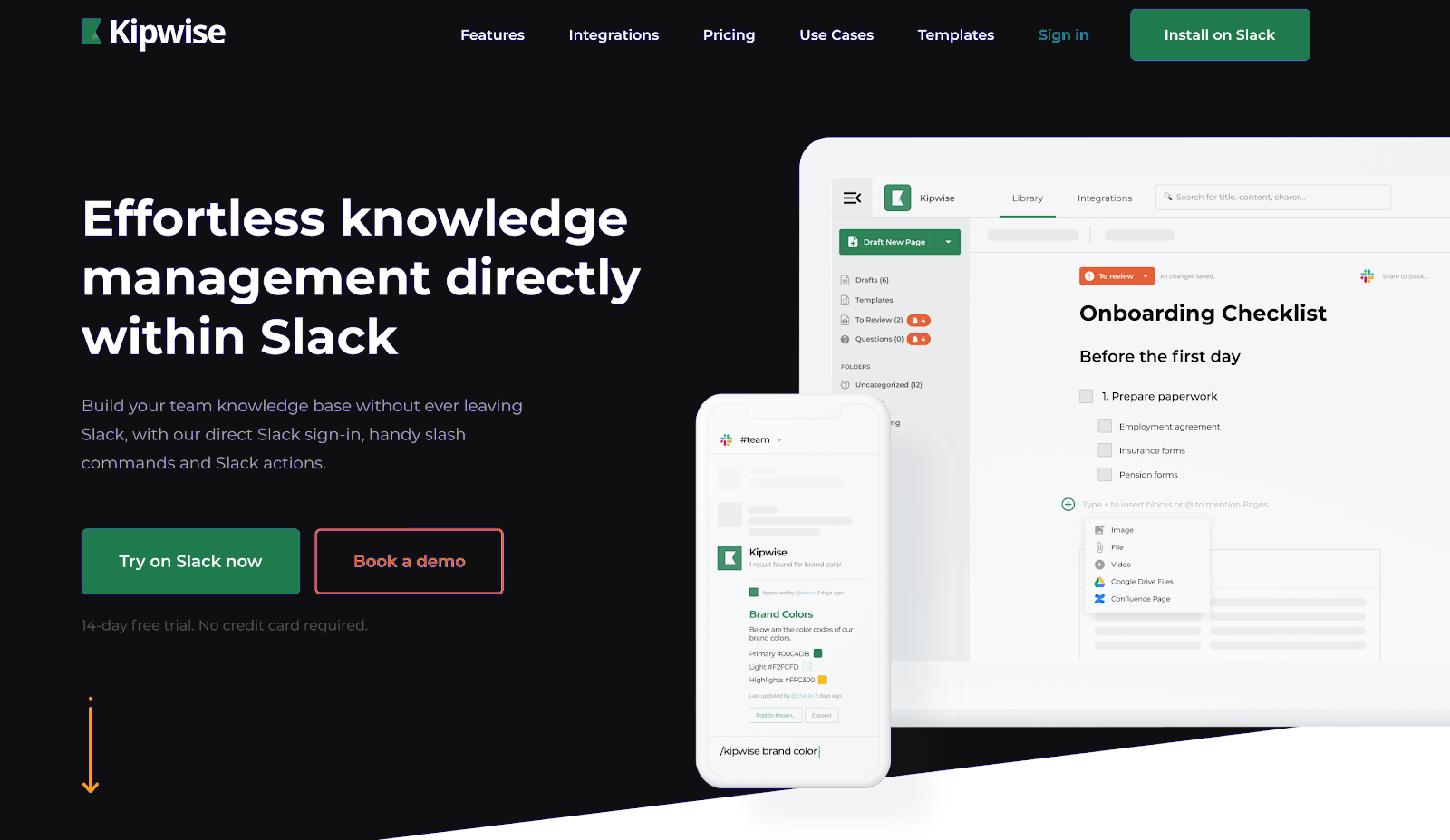
Kipwise is a knowledge management tool that helps teams build up their company knowledge hub easily. It offers powerful Slack integration, browser extensions and is integrated with Google Drive, Trello, Airtable and more, so you can save and retrieve team knowledge easily, wherever you need them.
Some key features that help teams enable better internal knowledge flow:
- Powerful Slack integration - Handy slash command and Slack Actions to create and search for team knowledge. You simply don’t have to leave Slack to build up your knowledge base.
- Real-time collaborative editor - With rich embedding options, your team can edit the same doc at the same time and create visually appealing documentation easily.
- Content review process - Set designated reviewers for your collections to ensure content is always up-to-date and accurate.
Pricing: $10 per user per month, minimum 3 users, with the knowledge base included
Best scheduling tools for startups
Founders spend a lot of time booking calls with investors, prospects and customers. A booking link replaces the email thread about which Tuesday works, and both free plans below are enough for one kind of call.
Calendly

With Calendly you set the times you are available, or connect your calendar to block the busy ones, and people book a slot themselves. You can share the link or embed the booking form on your website. The free plan has one event type and one calendar connection, so you start paying when you need separate links for, say, sales calls and support calls.
YouCanBook.me

YouCanBook.me works with Google, Apple and Microsoft calendars. Customers book straight into your calendar and get invites and reminders automatically. The free plan covers one calendar, one booking page and 30 bookings a month.
Best team culture tools for startups
We recommend skipping the culture, standup and time-off apps until the manual version breaks. With a handful of people, a #thanks channel, a recurring calendar event and a shared out-of-office calendar do the same job for free. Add an app when a specific thing fails: the standup thread stops getting read, two people miss each other’s leave, or thank-yous stop reaching teammates in other time zones.
Disco

Disco, a Slack and Microsoft Teams app for recognizing teammates with leaderboards, was acquired by Culture Amp (announcement). Culture Amp now offers Shoutouts, a recognition tool for Slack and Teams that comes with every Culture Amp subscription, and its support site tells Disco customers to uninstall Disco before installing it. A startup that does not already use Culture Amp is unlikely to want an HR platform just for kudos, so use a #thanks channel or Donut’s Shoutouts.
Donut

Donut pairs teammates for intro chats across departments, offices and continents, which suits a startup that works remotely (read more tips about remote work). It also posts celebrations and Shoutouts, its recognition feature, and Journeys can send new hires a sequence of onboarding messages. The free plan covers intros for up to 24 users per round in one Slack channel and up to five Shoutouts points per week.
Best holiday management tools for startups
Time off needs one record everyone can see, and it matters most for remote teams, where nobody notices that a teammate has left for the day. A shared calendar works until a missed absence costs you a deadline. Both tools below list a trial, not a free plan.
absence.io

absence.io handles vacations, business trips, sick leave and other absences in one shared team calendar. Through its Slack integration, managers can approve or decline requests in Slack, and teammates can see who is out with Slack slash commands. It has a 14-day trial.
Timetastic

Timetastic runs the whole time-off process, from request to approval, and its Business and Pro plans include a Slack integration so the team can prepare for an absence in advance. It is free for the first month.
Best daily standup and status report tools for startups
Steady (formerly Status Hero)

Steady, which was called Status Hero, prompts teammates for short check-ins and combines them with activity from connected tools such as Slack, GitHub, Jira, Zoom and Google Calendar. A Daily Digest delivers the result in Slack, Teams or email.
Standuply

Standuply runs standups, retrospectives and planning poker asynchronously in Slack and Microsoft Teams, so people in different time zones answer when they can. Connect it to Jira or GitHub to build agile charts. It has a 30-day free trial.
Best marketing tools for small startups
Buffer

Buffer schedules posts to several social accounts from one place and tracks how they perform. The free plan connects up to 3 channels with 10 scheduled posts per channel.
Semrush

Semrush is an SEO tool for keyword research, backlink analysis, competitor analytics and Google Ads optimization, aimed at growing your website’s traffic.
Best sales tools for small startups
Apollo

Apollo is for outbound sales: it finds verified email addresses and phone numbers for the prospects you want to reach, with filters for your ideal buyer. The free plan has no time limit but connects Gmail accounts only.
Yesware

Yesware, now branded Vendasta Yesware, adds email tracking, templates, automated outreach and a meeting scheduler to Gmail and Outlook. It offers a 14-day trial.
Close CRM

Close is a CRM with calling, email and SMS built in. Every call, text and email becomes part of the lead’s record, so a teammate who takes over a lead sees what was already said.
Best customer success tools for startups
Intercom

Intercom is a customer messaging platform. It puts a live chat messenger on your website and in your app, and sends in-app messages, product tours and email campaigns based on what a user does. It also sells Fin, an AI agent for customer questions.
Take the startup discount, but price the third year before you build on the tool. Intercom’s early-stage program, for companies with fewer than 15 employees and up to $10M in funding, takes 93% off in year one, 50% in year two and 25% in year three, and its page says that switching to another plan forfeits the year two and three discounts. You pay 7% of list price in year one, 50% in year two and 75% in year three, so put the step-down dates in your calendar and re-check whether you still need the tool.
Fullstory

Fullstory shows how prospects and customers use your website and product through heatmaps, conversion analysis and session recordings, which helps product, marketing and support teams alike. It has a Startup Plan for qualifying early-stage businesses; the page does not say what qualifies, so ask before you count on it.
Best product and design tools for startups
Figma

Figma is a browser-based design tool similar to Sketch, but built for teamwork: several people can work in the same file at once, like Google Docs, and in-app comments make design review simple. It connects to Slack for updates. The free Starter plan includes unlimited drafts.
Productboard

Productboard is a product management system for collecting what users need, prioritizing what to build, and sharing the roadmap with your team. It has 25+ native integrations, so feedback from the tools you already use can land in one place.
Visme

Visme is a visual content tool for presentations, infographics and branded marketing materials, with a digital asset manager for your logo, fonts and colors. The free Basic plan allows unlimited projects and 500 MB of storage, but downloads are limited to JPG, PNG and PDF, and published content carries Visme branding.
Best expense management tools for startups
Sage Expense Management (formerly Fyle)

Fyle is now Sage Expense Management. It scans receipts that employees send by text, email or the mobile app, flags duplicate receipts and over-limit expenses in real time when someone tries to submit, and matches credit card transactions to expenses and receipts. It syncs with Sage, QuickBooks and Xero.