25+ Slash Commands to Help You be More Productive on Slack
Slack slash commands that save you time
Slack's built-in slash commands are shortcuts for specific actions. Type the slash key (/) followed by a keyword in any channel or direct message to trigger one, for example /dnd to pause your notifications, without taking your fingers off the keyboard.
Typing / also opens a menu of the commands you can use, but memorizing the trigger words saves even more time.
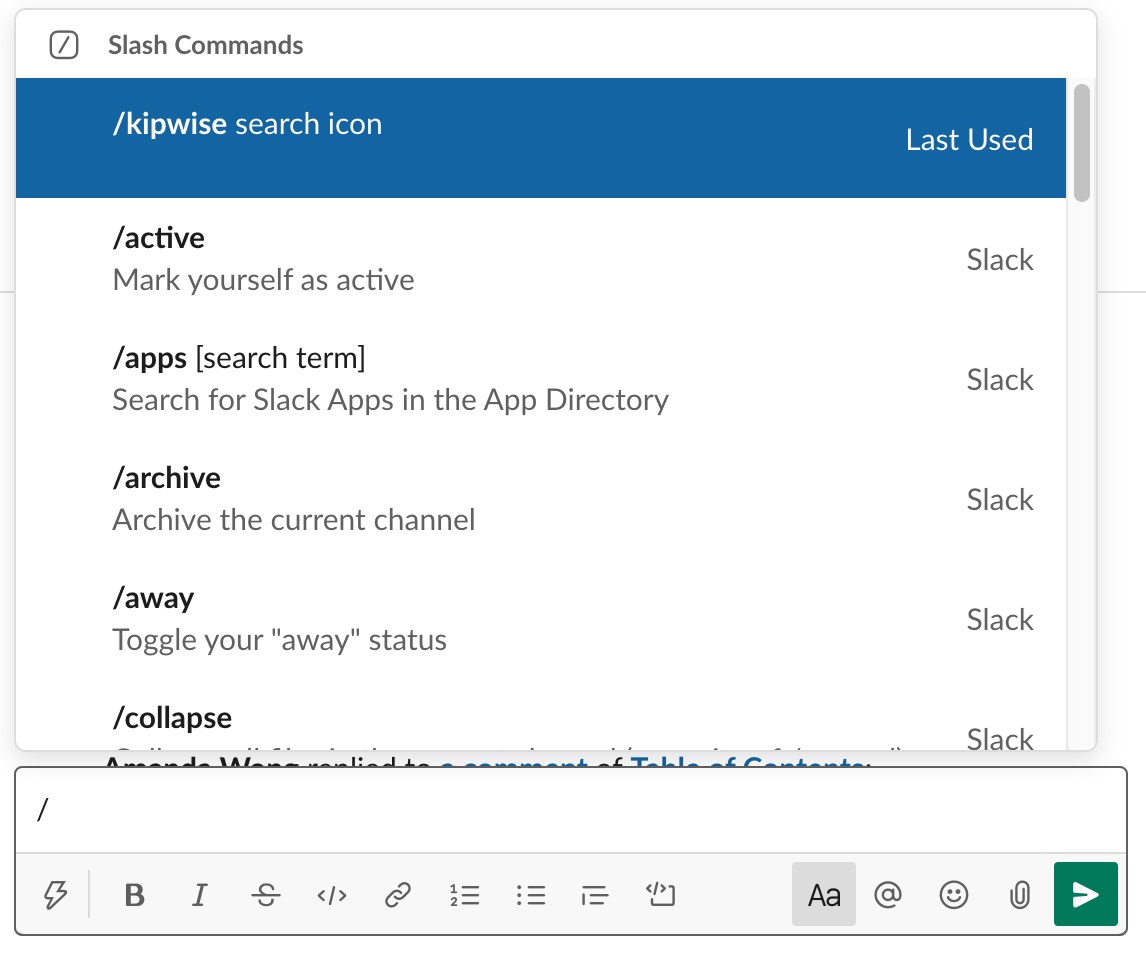
This list follows Slack's list of built-in shortcuts. Older guides, including earlier versions of this one, also list /away, /active, /apps, /me, /open, /join, /who and /remind help. They are not on Slack's list, so this guide no longer covers them. The /feed command is also not built in: it comes from an app, and has its own entry below.
To use the shortcuts of apps already installed in your workspace, click the slash icon next to the message field and search for app shortcuts. To find new apps, browse the Slack Marketplace or read our post Top Slack Apps for Productivity: 14 Picks by Use Case. To set yourself away or active, see /status in section B.
A. Slack slash commands to trigger Slack’s built-in functions
1. /remind [@someone or #channel] to [What] [When]
One of the Slack slash commands I use the most is /remind. Using this command, you can set reminders for yourself, for your teammate or even for a channel.
You can also set up recurring reminders for things teammates have to do regularly. The table below shows how to structure the command:
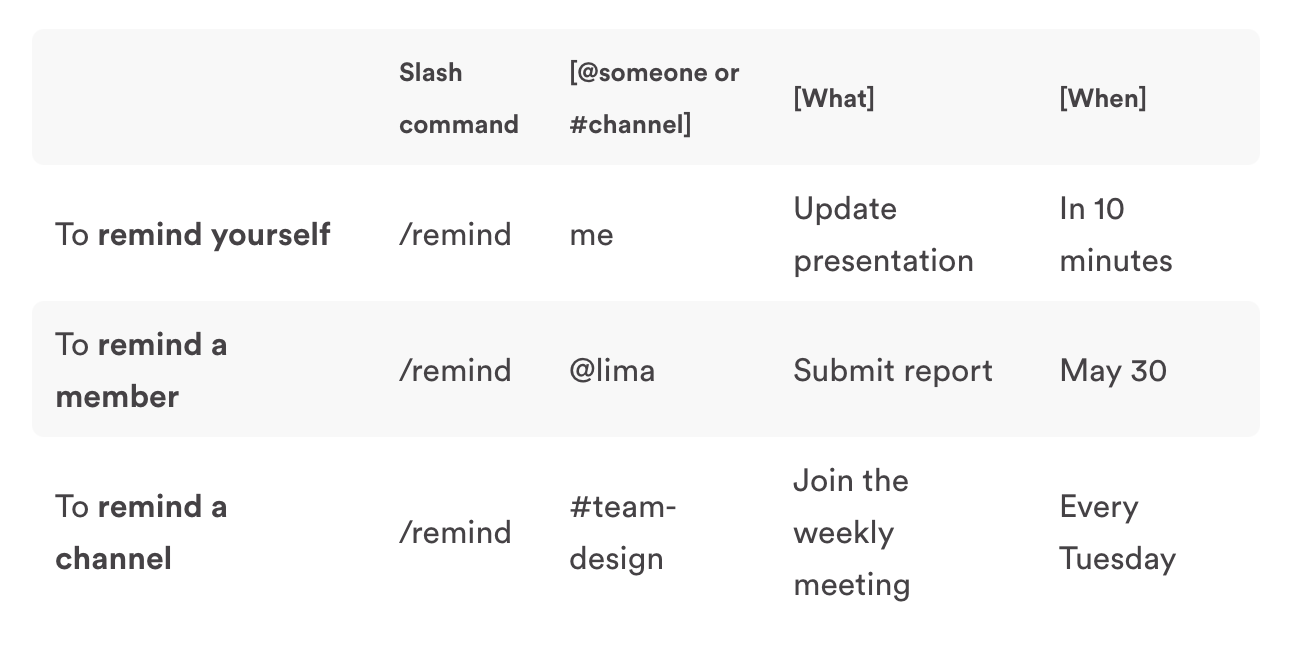
If you didn’t specify the exact time to send out the reminder when setting up the reminder, the Slack reminder will go out at 9am on the day you specified, unless you set a different default reminder time.
Some useful recurring reminders our team has set on Slack include:
/remind #team-cs to draft product update emails on the 15th of every month
This is a monthly reminder for the channel #team-cs to draft product update emails to our clients
/remind #team dev to “Before the sprint retrospective meeting, please
- 1. Tidy up Trello cards
- 2. Fill in feedback in latest sprint doc ” at 4PM every other Friday
This is a biweekly reminder for the channel #team-dev to reminder everyone on our development team to clean up the Trello board and add feedback before each sprint retrospective meeting
2. /remind list
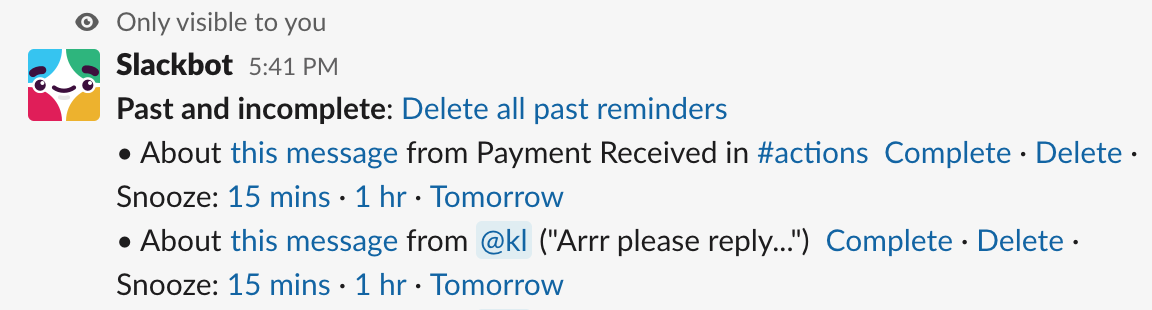
To see the reminders you have set for a channel, type /remind list. A message that only you can see shows them, and you can delete one from there. Reminders you set for yourself live in the To-dos tab.
3. /search [your text]
Search is another command you will use constantly: it finds any Slack message or shared file.
Type /search followed by your search terms, and refine the search with Slack's search modifiers.
Some of the useful ones include:
- from: @name to search for info shared by a specific person
- in: #channel to search for info shared in a particular channel
- in: @name to search for info shared in your direct message with a specific person
- before:date; after:date; on:date; or during:month or year to look for messages from a certain time frame
- has::emoji-code: to search only messages that received a specific emoji reaction, such as has::eyes:
- is:thread to search within threads, or with:@name to search threads and DMs with a specific person
- has:pin or is:saved to search pinned messages or your saved items
4. /shortcuts
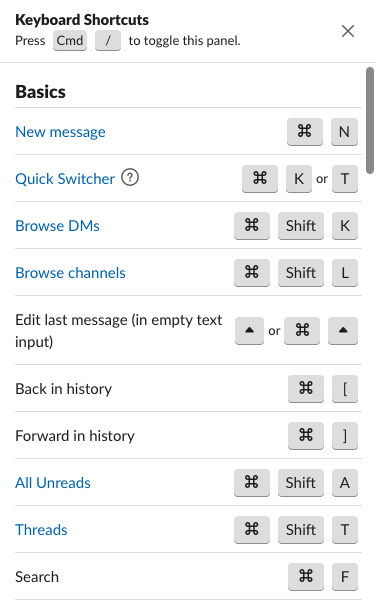
Slack shortcuts work alongside slash commands: keyboard shortcuts help you get around faster. Forgot one? Type /shortcuts to open the keyboard shortcuts panel.
5. /feedback [your text]
Have some feedback for Slack or want to create a help request to Slack? Type /feedback followed by your message to send feedback to Slack directly.
6. /feed subscribe [URL] (RSS app)
Slack's RSS app lets you subscribe to RSS and Atom feeds and get updates in the channel of your choice. /feed is not one of Slack's built-in commands, so add the RSS app from the Slack Marketplace first. Then find the RSS feed URL for the website you want to follow, and in the channel that should receive the updates, type /feed subscribe URL. /feed list shows a channel's feeds with their ID numbers, and /feed remove [ID number] unsubscribes.
7. /drafts
To get back to a message you started and never sent, type /drafts to view your draft messages. This command is not available in the Slack mobile apps.
8. /mentions
To catch up on where people mentioned you or reacted to your messages, type /mentions to view your mentions and reactions. This command is not available in the Slack mobile apps.
9. /saved
To open the messages and files you saved for later, type /saved to view your saved items.
10. /snippet
To share a block of code or text as a snippet, type /snippet to create one. This command is not available in the Slack mobile apps.
11. /darkmode
To turn dark mode on or off, type /darkmode. This command is not available in the Slack mobile apps.
12. /huddle
To start a huddle, type /huddle. On the free plan a huddle can have at most two participants, so it works as a one-to-one call there; paid plans allow up to 50 participants, with video for up to 25 of them. If your free workspace needs a group call, send a meeting link from a video tool instead of starting a huddle your team cannot join.
B. Slack commands to quickly set your availability and status
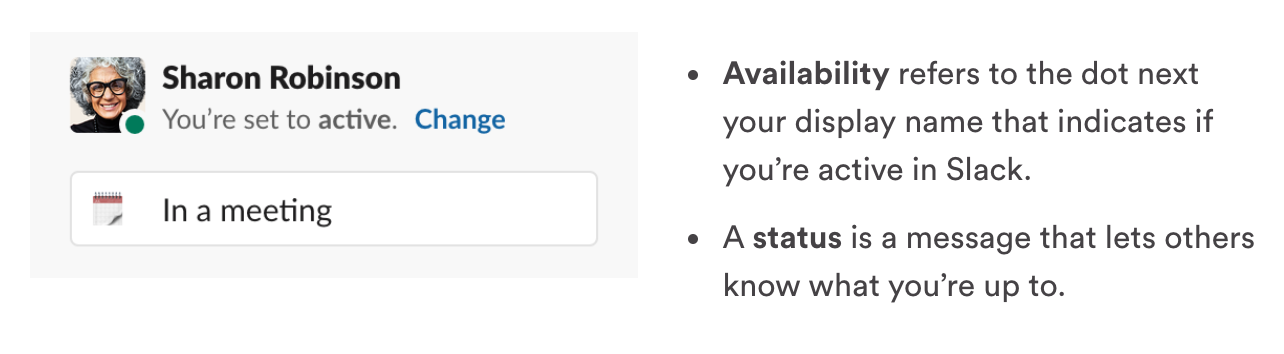
Teammates should be able to tell whether you are available and how quickly to expect a response. You can show this by setting your availability and status in Slack.
13. /dnd [some description of time]
To help you focus on work, you can pause your Slack notifications with Do Not Disturb (DND) mode. After you have turned on DND mode, your teammates will see a DND icon next to your name and they will have a choice to override DND to notify you about an urgent message when sending a direct message.
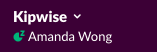
To quickly turn on DND mode for a set period of time, type /dnd followed by the time frame, e.g. /dnd for 15 mins or /dnd until 5pm.
14. /status
Other than the availability icon, you can also set a status emoji and custom status message to communicate your availability.
After you set a status in Slack, your teammates will be able to see the status emoji next to your name and they can see the full status message in your profile or when hovering over your status emoji.
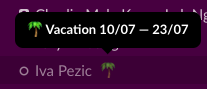
To quickly set your status, type /status followed by :emoji code: and your custom message, e.g. /status :spiral_calendar_pad: In a meeting.
/status can also set your status to away or active. If you prefer the menu, click your profile picture and choose Set yourself as away or Set yourself as active. Left alone, Slack sets you to away after 10 minutes of desktop inactivity, or when you close the mobile app.
C. Slash commands related to sending messages
15. /msg [#channel or @someone] [your message]
To quickly send a message to a channel, or a direct message to a teammate, instead of needing to scroll through the channel and teammate lists on the sidebar, you can use the slash command /msg. Examples: /msg #team-dev I’m running a little late for the meeting or /msg @amanda I’m running a little late for the meeting. To view your direct messages instead, type /dm (not available in the Slack mobile apps).
16. /shrug [your message]
To help express yourself, you can quickly append the shrug symbol ¯\_(ツ)_/¯ to the end of your message by using the slash command /shrug.
D. Slack commands related to channel management & navigation
17. /browse channels
To see the channels in your workspace, type /browse channels. This command is not available in the Slack mobile apps. To browse the files in your workspace, type /browse files.
18. /collapse or /expand
Sometimes if there are many links or files shared in a chat, the image previews can take up quite a lot of spaces, making it hard to scan through the messages quickly. To make your chat window cleaner, there is a way to collapse all inline image previews for files or links shared.
To do so, use the slash command /collapse to collapse everything or type /expand if you want all the previews back.
19. /leave
If a channel is no longer relevant to you, for example, you changed your role and are no longer involved in a particular project, you can leave it by typing /leave in the channel that you would like to quit.
20. /mute
Sometimes you might not need to keep track of the daily activities of a channel but still want to be in the channel so that you can check out the activity when you want to, you can mute the channel to minimize distractions.
Muted channels are typically hidden from your sidebar, and you can choose in your preferences whether to show or hide them. After you have muted a channel, you will not receive notifications about new activity in it, but you'll still see a numbered badge next to it if you’ve been mentioned or received a DM.
To mute a channel, type /mute to the channel that you’re currently viewing to mute it or type /mute #channel-name to mute another other channels. To un-mute the channel, use the same slash command.
You can also use the slash command /mute to mute or unmute a direct message or message thread that you’re currently viewing.
21. /rename [new name]
To quickly rename a channel, type /rename followed by the new channel name that you want to use. This command may be restricted to owners and admins.
22. /topic [text]
When organizing your Slack channels (read more tips on how to better organize your Slack channels), it’s also a good practice to always add a clear channel topic and description so that teammates will be clear how each channel should be used. You can also add useful links in the topics field so that teammates can easily access them. For example, you can put the Trello board link for a project in the relevant project channel.
To quickly set the topic of a channel, type /topic followed by the topic text you want to use.
23. /archive
If a channel is no longer active, you can archive it instead of deleting it so that the history will be kept. An archived channel will no longer be shown in the left sidebar and your teammates will not be able to post new messages to an archived channel, but the history will be retained, and on paid plans your teammates can still search for it and view it.
To archive a channel, type /archive in the channel that you want to archive it. This command may be restricted to owners and admins.
E. Slash commands related to teammate management
24. /invite @someone [#channel]
You can use this command to invite a team member to join the specified channel. For example: /invite @amanda #team-cs will invite Amanda to join the #team-cs channel. The invited teammate will receive a notification to invite them to join the channel.
25. /remove (or /kick) @someone
This command will remove a teammate from the channel you typed this command into. It may be restricted to owners and admins.
26. /people
To browse the people and user groups in your workspace, type /people.
Slack keyboard shortcuts (Mac and Windows)
Keyboard shortcuts get you around Slack without the mouse, the same way slash commands do from the message field. Press ⌘ / on a Mac or Ctrl / on Windows for the full list (or type /shortcuts). These are the ones that save the most time (the full list is on Slack's keyboard shortcuts page):
| Action | Mac | Windows |
|---|---|---|
| Show the full list of shortcuts | ⌘ / |
Ctrl / |
| Compose a new message | ⌘ N |
Ctrl N |
| Start a search | ⌘ G |
Ctrl G |
| Search in the current conversation | ⌘ F |
Ctrl F |
| Set your status | ⌘ Shift Y |
Ctrl Shift Y |
| Create a new canvas | ⌘ Shift N |
Ctrl Shift N |
| Start, join, leave or end a huddle | ⌘ Shift H |
Ctrl Shift H |
| Open the Threads view (desktop app) | ⌘ Shift T |
Ctrl Shift T |
| Browse channels (desktop app) | ⌘ Shift L |
Ctrl Shift L |
| Jump to the previous or next channel or DM in the sidebar | Option ↑ or Option ↓ |
Alt ↑ or Alt ↓ |
| Jump to the previous or next unread channel or DM | Option Shift ↑ or Option Shift ↓ |
Alt Shift ↑ or Alt Shift ↓ |
| Mark all messages in the current conversation as read | Esc |
Esc |
| Mark all messages as read | Shift Esc |
Shift Esc |
| Bold or italicize selected text in the message field | ⌘ B or ⌘ I |
Ctrl B or Ctrl I |
| Create a new line without sending | Shift Enter |
Shift Enter |
With a message in focus, one-key shortcuts take actions on it: E edits a message you sent, F forwards it, P pins or unpins it, A saves it, M creates a reminder about it, R adds an emoji reaction and T opens or replies to its thread. Shortcuts marked with an asterisk on Slack's page may differ if your keyboard is set to a language other than English, and it is not currently possible to set custom keyboard shortcuts for Slack.
Slack bot commands
Slackbot, Slack's built-in assistant, is now an AI agent you talk to in plain language. Click Slackbot at the top of your sidebar, type or dictate a request, and keep it short and precise, with references to the files, channels or Salesforce records you want it to use (how to work with Slackbot). One of Slack's own examples is "Which direct messages or mentions do I need to follow up on this morning?" Slackbot is on the Business+ and Enterprise+ plans, with a limited preview on the free and Pro plans (guide to AI features).
The classic slash commands still work next to it. /remind sets a reminder in the format /remind [#channel] [what] [when], for example /remind #marketing-team to submit expenses every Thursday, and you can also ask Slackbot to create reminders for you. Slackbot can also take Slack actions for you, with your approval: send messages on your behalf, update your sidebar, set your status and act on channels, for example adding people or archiving.
We recommend keeping routine actions on slash commands and saving Slackbot for questions that need judgment. On Business+, each member can send 15 messages to Slackbot per week, counted Monday to Sunday, so asking it for a reminder that one /remind line would set spends part of an allowance you may want for questions like "which messages do I need to follow up on?" Enterprise+ has no weekly cap, and on the free and Pro plans Slackbot is only a trial or preview.
Apps you add to Slack can include their own shortcuts, and app developers decide what each one needs. Type / in the message field to see the ones available in your workspace.
Prefer not to remember commands at all? Kipwise Agent takes plain English instead: say what you want in the thread, such as "remind me on Monday" or "write this thread up as a page", and it asks you to approve any change before it makes it.
Frequently Asked Questions About Slack Slash Commands
Do slash commands work in all Slack channels?
Yes, most slash commands work in all channels, direct messages, and group conversations. However, some commands like /rename, /archive, and /remove require specific permissions and may only work for channel admins or workspace owners. Commands like /topic and /invite also depend on your role and channel settings.
Can I create custom slash commands for my team?
Yes, Slack allows you to create custom slash commands through Slack apps or integrations. You can build custom commands that trigger specific workflows, integrate with external tools, or automate repetitive tasks specific to your team's needs. This requires some technical setup or using third-party integration platforms.
What happens if I make a mistake with a slash command?
Most slash commands can be undone or corrected. For example, if you accidentally set the wrong status with /status, run the command again with the correct information. For commands like /archive or /remove, you may need admin permissions to reverse the action. Always double-check channel names and user mentions before executing commands.
Do slash commands work on mobile devices?
Most do. Slash commands work on Slack's mobile apps (iOS and Android) and desktop versions, and the command menu that appears when you type "/" helps you discover them. A few commands, such as /browse channels, /snippet, /darkmode, /dm, /downloads, /drafts, /mentions and /workflow, are not available in the mobile apps.
How can I remember all these slash commands?
Start with the most useful ones for your workflow - typically /remind, /search, /status, and /dnd. You can always type "/" in any channel to see the available commands, or use /shortcuts to view keyboard shortcuts. Focus on memorizing 3-5 commands that you'll use daily, then gradually add more to your routine.
Are there keyboard shortcuts that work alongside slash commands?
Yes, Slack offers many keyboard shortcuts that complement slash commands. Use /shortcuts to see the full list. Popular ones include Ctrl+K (or Cmd+K) to quickly jump to channels, Ctrl+/ (or Cmd+/) to open the shortcuts menu, and Alt+↑/↓ to navigate between channels.
Can I use slash commands to integrate with other tools?
Yes, many third-party apps and integrations add their own slash commands to Slack. For example, you might have commands for Trello, Google Drive, Zoom, or project management tools. To see the ones available in your workspace, click the slash icon next to the message field and search for app shortcuts or slash commands.
Do slash commands work in Slack threads?
Most slash commands work in threaded conversations, but their scope may be limited to the thread context. For example, /mute in a thread will mute that specific thread, while /remind can still set reminders normally. Some commands like /topic or /rename affect the entire channel regardless of where they're used.
Why don't some slash commands work for me?
Command availability depends on your role and permissions in the workspace. Regular members can use most basic commands, but commands like /rename, /archive, /remove and /create channel may be restricted to owners and admins, and /create workflow is only available on paid plans. Check with your Slack admin if you need access to specific commands.
Can I see a history of slash commands I've used?
Slack doesn't provide a dedicated history of slash commands, but actions triggered by commands (like setting reminders, changing status, or sending messages) appear in your regular message history. You can use /remind list to see the channel reminders you can delete and /search to find messages or actions you've performed using commands.
An AI agent that works inside your Slack threads
Kipwise Agent works in the thread, as you. Mention it once and every plain reply in that thread continues the conversation.
- “Do we have a doc about this?” It searches your knowledge base, reads the page, and answers with the relevant part and a link to the source
- “Can someone write this up?” It drafts a page from what was said in the thread, files it in the folder you name, publishes it and posts the link
- “Move this deal to Negotiation” It updates the deal or the ticket in your CRM and logs the note, as you
- “Remind me on Monday” It runs a request later or on a schedule and posts the result in the channel
It only ever sees the pages you can see, and everything it writes in Kipwise is attributed to you.