How to Automate HRIS Onboarding Sync with an AI Company Brain
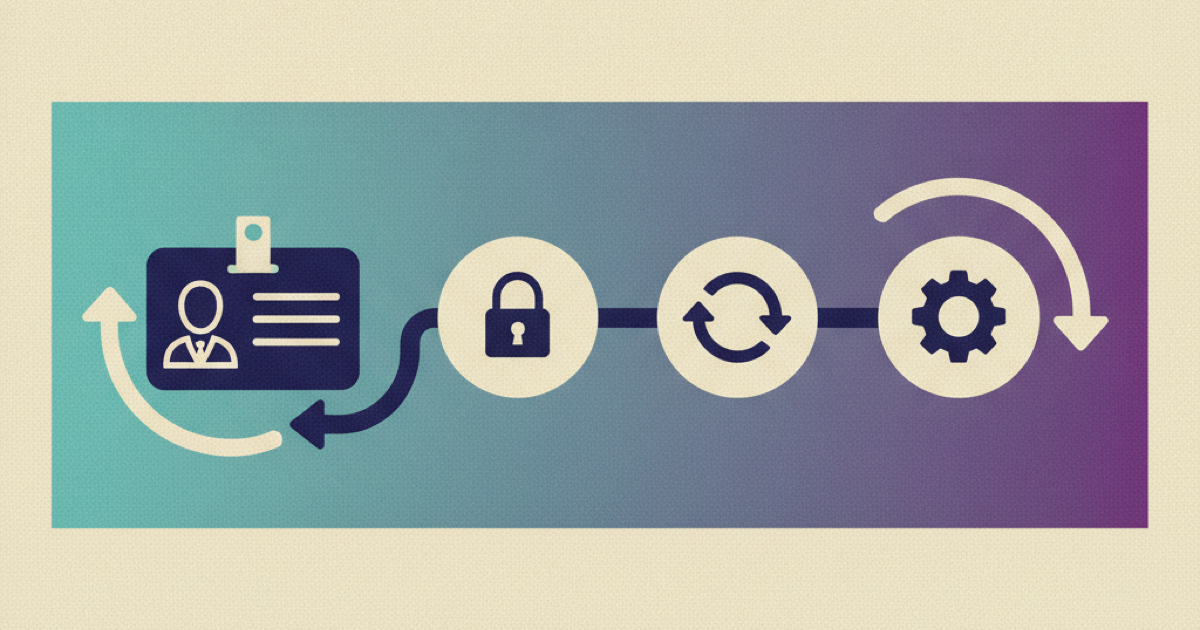
HRIS onboarding automation fails when it copies employee data once and assumes nothing will change. A delayed start date, new manager, corrected location, or last-minute role change can leave a new hire with the wrong checklist and the wrong knowledge access. The fix is not another nightly export. Build a lifecycle contract that carries each approved HRIS event through identity provisioning, onboarding assignments, retrieval filters, and verification. This guide shows People Operations and IT owners how to design that contract, handle conflicting updates, and prove that the company brain reflects the employee's current state.
Why one-time onboarding sync fails
An onboarding workflow usually starts before the employee signs in. People Operations creates the worker record, IT provisions an identity, and a knowledge system assigns reading. Each system may take its own copy of department, manager, location, employment type, and start date. Those copies drift as soon as one field changes.
The danger is larger than a missing task. A stale department can expose team-only documents. An old location can retrieve the wrong leave or payroll policy. A postponed start date can activate employee knowledge too early. A manager correction can send approvals and escalation questions to someone who is not responsible for the hire.
A company brain adds another stateful layer. It may cache profile attributes, index documents under group labels, or preserve a conversation created under an earlier access context. Retrieval can therefore be technically successful while producing an answer from the wrong source set.
Treat the HRIS as the workforce source, but do not let it directly authorize every document. HR data says who the employee is and where they sit in the organization. The identity platform turns approved attributes into accounts and groups. The knowledge layer applies those current groups when it retrieves content. This separation follows the current-context access principle described in NIST SP 800-207.
Define the lifecycle contract first
Before connecting APIs, document one contract shared by People Operations, IT, and knowledge owners. The contract should define four things for every attribute:
- Authority: Which system owns the value?
- Trigger: Which event makes a change actionable?
- Effect: Which identity, task, or retrieval state must change?
- Deadline: How quickly must the effect become visible?
Use a small set of states rather than dozens of application-specific flags:
planned -> approved -> active -> changed -> suspended -> endedA worker can move backward from approved to planned when a start date is postponed. A role correction after activation produces changed, not another joiner. Suspension blocks access without erasing the record. Ended removes active access and closes onboarding work according to the retention policy.
Microsoft Entra lifecycle workflows provides a useful model for automating joiner, mover, and leaver tasks from employee attributes and time-based conditions. Use that model even if your identity provider is different. The important part is an explicit state transition with an owner, timestamp, and repeatable action.
Keep the employee identifier stable across systems. Email is a poor primary key because names and domains can change. Use an immutable workforce ID in the HRIS, map it to the identity provider's stable object ID, and store both on the onboarding profile. The SCIM protocol specification defines standard operations for creating, retrieving, modifying, and deleting identities across domains. It also gives teams a common vocabulary for provisioning behavior.
Map attributes to bounded effects
Do not send the entire HR record to the company brain. Create an allowlist of attributes that have a defined onboarding effect. A practical initial map looks like this:
| HRIS attribute | Identity effect | Onboarding effect | Knowledge effect |
|---|---|---|---|
| start date | schedule activation | shift due dates | open employee sources on activation |
| department | update group | assign team path | filter team documents |
| location | update location claim | assign local tasks | filter regional policies |
| manager ID | update sponsor | route approvals | route unanswered questions |
| employment type | update access package | select worker path | exclude inapplicable policies |
| end date | schedule removal | close open tasks | revoke retrieval access |
This map prevents accidental coupling. A phone-number correction should not rebuild an index. A title spelling change should not grant a privileged group. Every attribute that can change access needs a named owner and a test case.
Store the minimum attributes needed for selection. The company brain usually needs current groups, location scope, employment stage, and perhaps manager routing. It does not need salary, health data, banking details, or private recruiting notes. Minimizing copied data also makes deletion and incident review easier.
Build an idempotent HRIS onboarding automation pipeline
Use events for speed and reconciliation for correctness. The HRIS emits or exposes a changed worker record. An integration service validates the event, looks up the stable identity, calculates the desired state, and sends bounded changes to downstream systems.
on employee_changed(event):
 assert event.worker_id is present
 current = read_authoritative_hris_record(event.worker_id)
 desired = derive_allowed_onboarding_state(current)
 previous = read_last_applied_state(event.worker_id)

 if desired.version <= previous.version:
 acknowledge_as_duplicate(event)
 return

 apply_identity_changes(desired.identity)
 apply_onboarding_assignments(desired.tasks)
 apply_retrieval_context(desired.access)
 verify_end_to_end(desired)
 record_applied_state(desired.version)
Make each operation idempotent. Replaying the same approved event should produce the same groups, tasks, and filters without duplicate assignments. Record a source version or update timestamp so an older event cannot overwrite a newer correction.
Do not trust event order. Webhooks can be delayed, duplicated, or delivered after a retry. Read the current authoritative record before calculating the desired state. Then compare versions and converge downstream systems on that state.
A nightly or hourly reconciliation job should compare active HRIS records with identities and onboarding profiles. Events reduce delay; reconciliation catches missed events, connector outages, and manual edits. Report mismatches as specific repairs, such as location group missing, rather than a generic sync error.
Apply access during retrieval
Updating an onboarding profile is not enough if the search layer ignores it. Apply access filters before candidate documents reach the model. Microsoft's document-level access guidance describes patterns that attach user or group criteria to indexed documents and enforce them at query time.
The request path should resolve the signed-in identity, fetch current trusted claims, calculate permitted document scopes, retrieve only from those scopes, and then generate an answer with source citations. Never ask the model to remove forbidden passages after broad retrieval. By then, restricted text has already entered the generation context.
Invalidate cached access context after a relevant identity change. If a new hire moves from Sales to Finance, an existing chat session must not continue retrieving with the Sales group until logout. Use short-lived authorization context or a version check on each request. Clear or reauthorize sessions when the identity version changes.
Do not broaden access because one downstream system is late. If the HRIS says Finance but the identity group update is pending, fail closed for Finance-only sources and show a useful status message. Route the access issue to the named owner instead of returning a generic answer from whatever documents remain visible.
Handle changes and conflicts safely
Not every update should apply automatically. Define decision rules before launch:
- Apply low-risk corrections, such as a delayed start date, when the authoritative HRIS version is newer.
- Require approval when a change grants a privileged group or executive knowledge scope.
- Suspend, rather than delete, access during an investigated employment-status conflict.
- Keep the previous restrictive state when two systems disagree about a broader entitlement.
- Escalate missing manager, location, or employment-type fields before assigning dependent tasks.
For example, suppose Maya is hired for Customer Success in London. Two days before her start, the HRIS changes her department to Implementation and her manager to Arun. The integration should remove the Customer Success onboarding path, assign the Implementation path, change the manager route, update identity groups, and invalidate the old retrieval context. It should preserve completed company-wide tasks and avoid duplicating them.
The verification step then signs in through a testable access evaluator, confirms that Maya can retrieve the UK employee handbook and Implementation playbook, and confirms that she cannot retrieve Customer Success team notes. This closes the gap between a successful HRIS update and an actually correct onboarding experience.
Verify the full path
A green webhook log proves only that one request returned. Verification must cover the complete chain from workforce record to answer.
Create a test matrix for these cases:
- approved hire with a future start date
- postponed start date after preboarding begins
- department and manager change before day one
- location correction after activation
- duplicate and out-of-order events
- identity provider outage during an update
- missing required attribute
- suspension and end-date processing
For each case, assert the HRIS version, identity groups, onboarding assignments, retrieval scopes, visible sources, blocked sources, and escalation owner. Include a source-backed question, such as "Which regional leave policy applies to me?", because group membership alone does not prove the answer path works.
Track operational measures that lead to action: event age, unapplied changes, reconciliation mismatches, access-filter version, failed assignments, and time to repair. Do not collapse them into one health score. An operator needs to know whether to repair the HRIS record, identity connector, task assignment, or search filter.
The public GitLab onboarding handbook shows why this coordination matters: onboarding combines employee details, access requests, role tasks, owners, and support routes. Kipwise's employee onboarding workflow similarly connects assigned reading, searchable knowledge, and progress. Your synchronization contract must keep those parts aligned rather than treating access as a separate IT ticket.
Common implementation mistakes
The first mistake is syncing on email. Use stable IDs and treat email as a mutable attribute.
The second is granting access directly from every HRIS field. Map approved attributes to bounded effects and require review for privileged changes.
The third is updating groups without invalidating chat or retrieval context. Tie each request to the current identity version.
The fourth is trusting webhook delivery as the source of truth. Re-read the current record and run reconciliation.
The fifth is testing only the happy-path account creation. Changes, delays, duplicates, suspension, and partial outages are where stale onboarding state appears.
Put one lifecycle change through the system
Start with a single controlled scenario before automating every application. Choose a department change for a test employee. Record the expected identity groups, onboarding assignments, permitted documents, denied documents, and manager route. Send the HRIS change, observe each transition, and ask one source-backed onboarding question through the company brain.
Do not expand the integration until the downstream state matches the contract and the denied-source check passes. Once that path is reliable, add start-date, location, employment-type, and end-date events one at a time.
References
- Microsoft Entra lifecycle workflows supports joiner, mover, and leaver workflow design based on employee attributes and lifecycle events.
- SCIM protocol specification, RFC 7644 defines standard cross-domain identity provisioning operations.
- Microsoft document-level access control supports filtering searchable documents by current user or group access.
- NIST SP 800-207 supports access decisions based on current identity, resource, and policy context.
- GitLab onboarding handbook provides a practitioner-maintained model of structured onboarding tasks, access requests, owners, and support paths.
- Kipwise employee onboarding provides product context for assigned reading, searchable knowledge, and onboarding progress.